
Blog
What Are Peptides? A Simple Guide to What They Do


Peptides appear in conversations about weight loss, skincare, exercise recovery, and healthy aging. But the word covers many different molecules and products.



Some peptides occur naturally in your body. Some have been developed into prescription medicines. Others are materials used in laboratory research.
Understanding these differences makes peptide information much easier to navigate.
Key takeaways
– Peptides are short chains of amino acids—the building blocks of proteins.
– Many natural peptides help cells communicate.
– Different peptides have different functions, evidence, and risks.
– Research-use products are intended for laboratory investigation, rather than personal treatment.
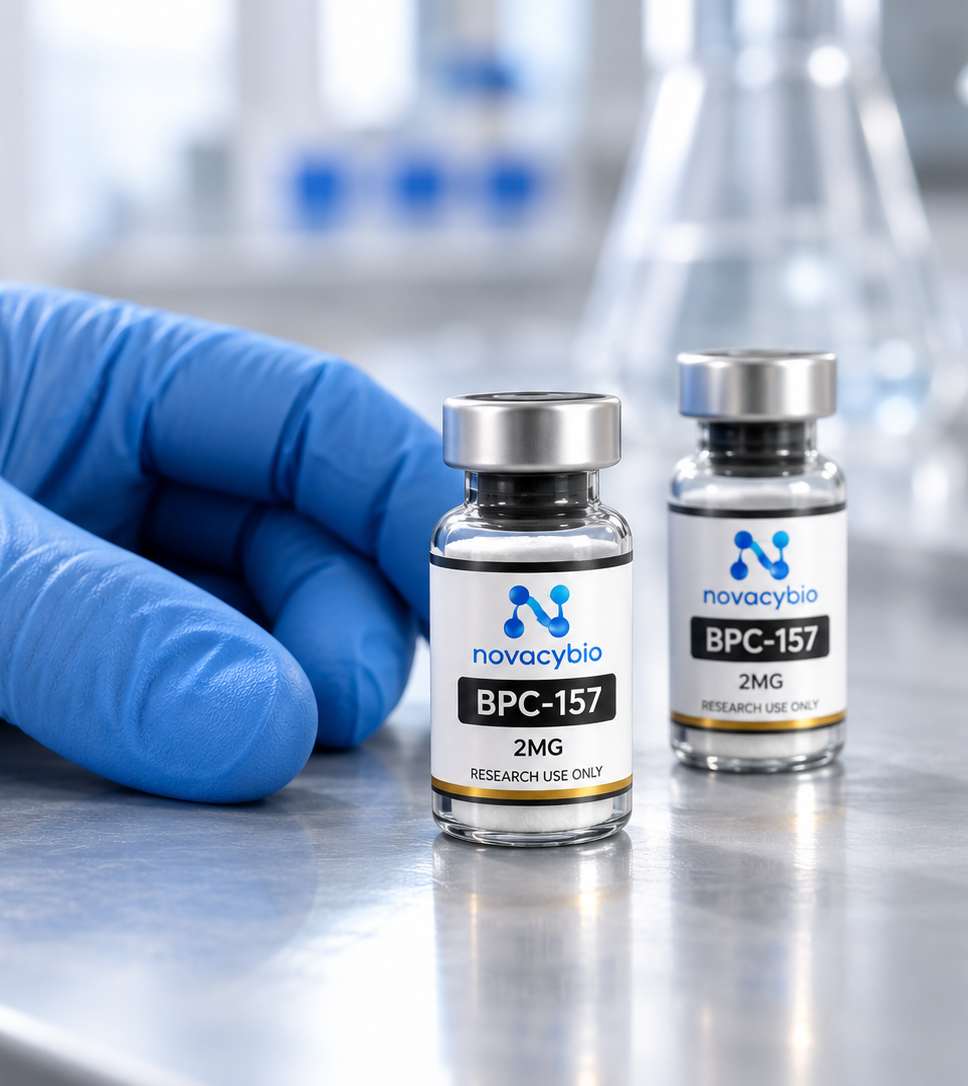
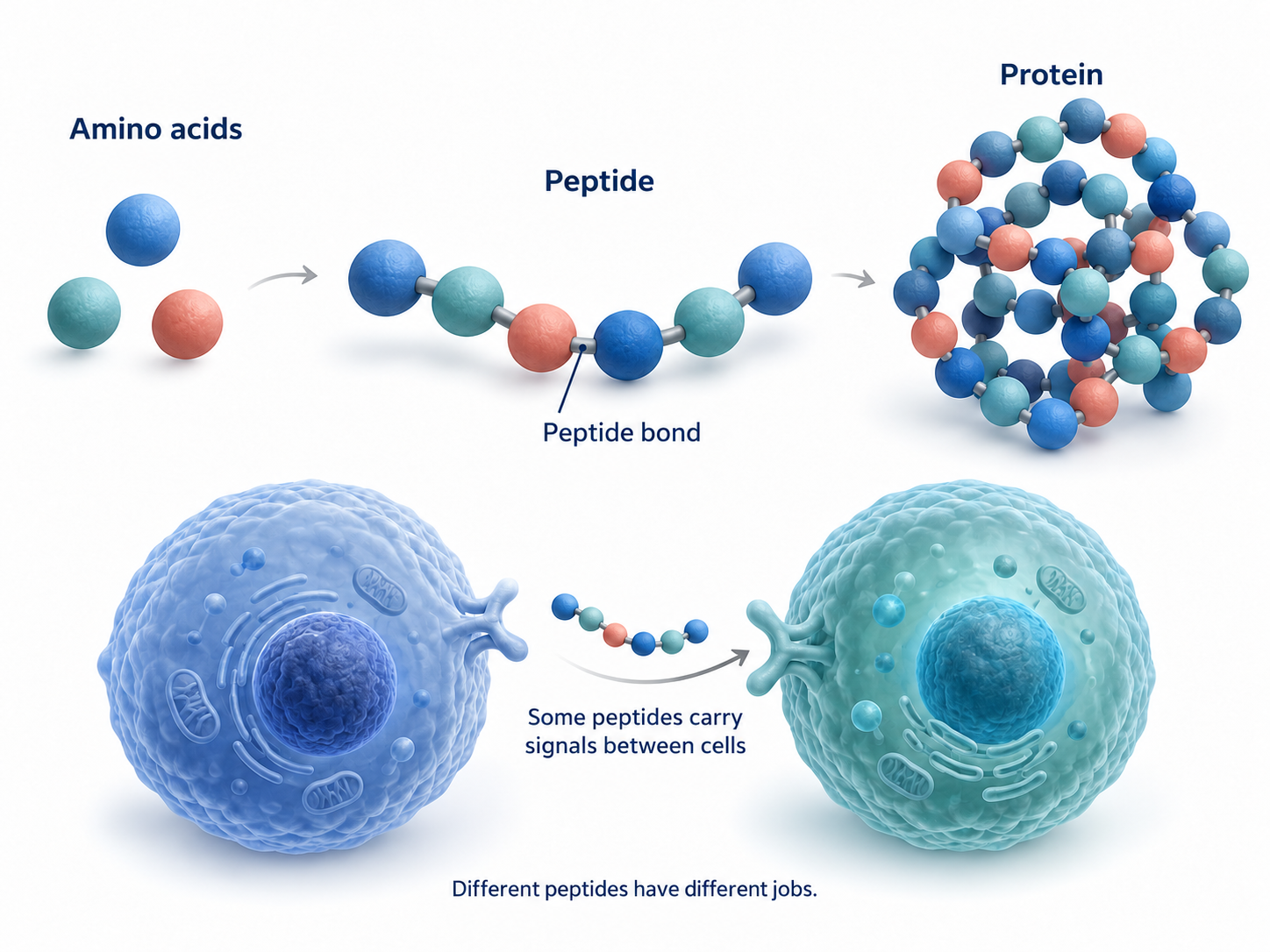
What Are Peptides?
Peptides are short chains of amino acids connected by chemical links called peptide bonds. Amino acids are also the building blocks your body uses to make proteins.
Think of amino acids as individual beads. Link a small number together, and you have a peptide. Longer chains can form proteins.
Your body naturally makes many peptides. Some carry messages between cells, helping different parts of the body coordinate their activities.
“Peptide” describes a broad group of molecules, rather than one treatment or one benefit. Two peptides can have very different jobs.
Peptides vs. Proteins: What Is the Difference?
Peptides and proteins share the same building blocks. Peptides generally have shorter chains, while proteins tend to have longer chains and more complex structures.
Peptides and proteins share the same building blocks. Peptides generally have shorter chains, while proteins tend to have longer chains and more complex structures.
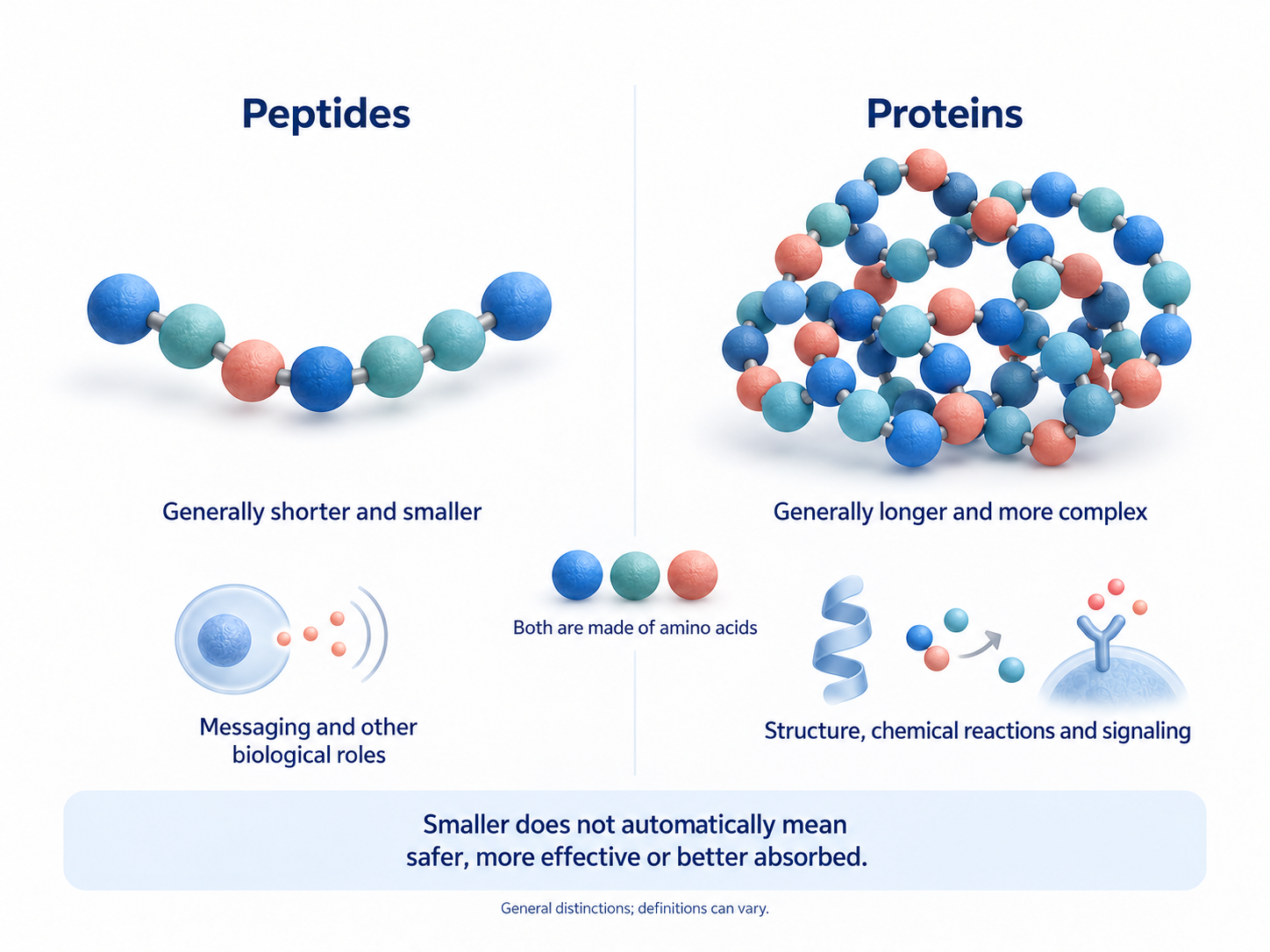
| Question | Peptides | Proteins |
|---|---|---|
| What are they made of? | Amino acids | Amino acids |
| How big are they? | Generally smaller | Generally larger |
| What do they do? | Can act as messengers and perform other biological roles | Perform many roles, including structural support, chemical reactions, and signaling |
These are general distinctions. Scientific and regulatory definitions can vary.
Being smaller does not automatically make a peptide safer, more effective, or easier for the body to absorb. Those characteristics depend on the specific molecule and product.
What Do Peptides Do?
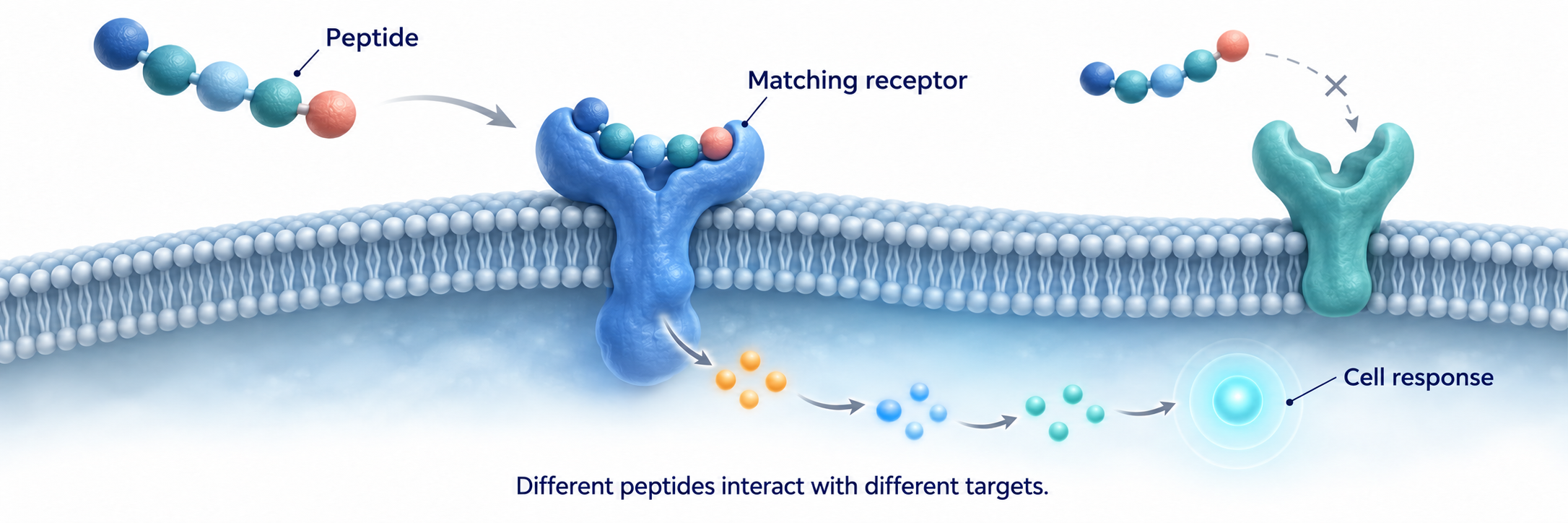
Many peptides help deliver signals.
Imagine a cell has a doorbell. A particular peptide can interact with the right “doorbell”—called a receptor—and trigger a response.
Different peptides interact with different targets. This helps explain why peptides can be involved in very different biological processes.
-Appetite and Metabolism
Some peptide signals help coordinate hunger, fullness, and how the body handles nutrients.
-Hormone Signaling
Certain peptides carry messages between tissues and organs, helping coordinate biological activity.
Some peptides participate in the body’s defense and inflammatory processes.
-Communication Between Cells
Peptides can help cells respond to changes in their surroundings.
These natural roles explain scientific interest in peptides. They do not establish that using a peptide product will improve the same functions.
–A useful question to ask
Instead of asking only “Do peptides work?”, ask: Which peptide, for what purpose, and supported by what evidence?
Why Are People Interested in Peptides?
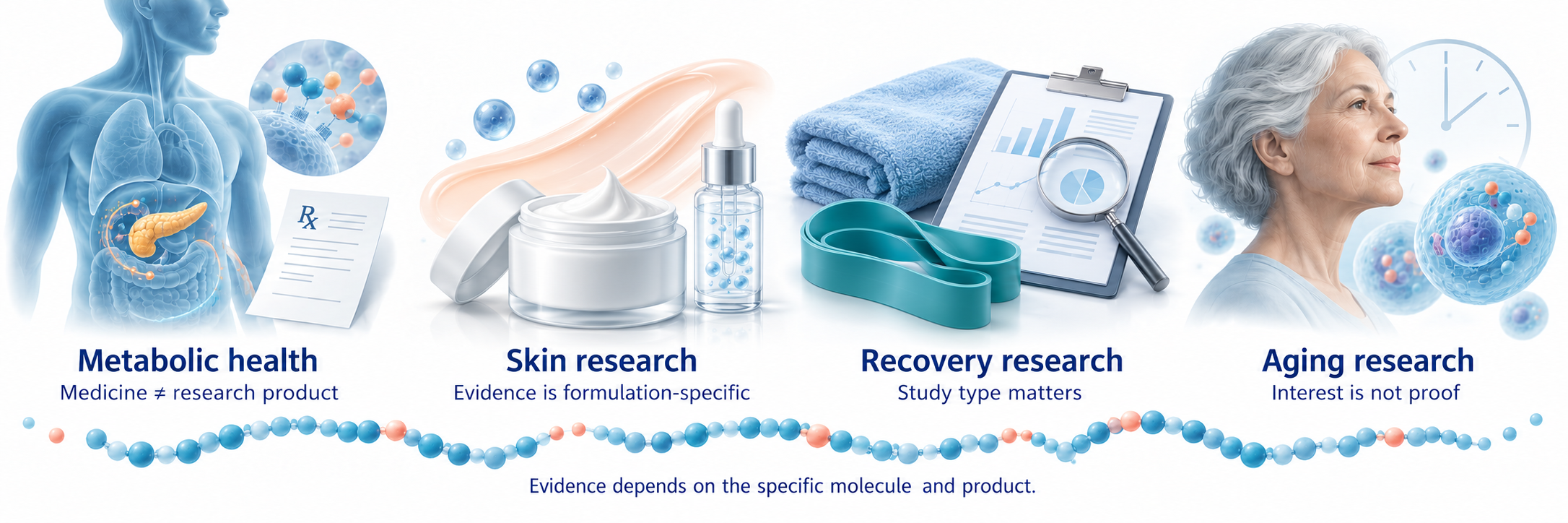
Peptides attract attention because some interact with specific biological targets. Scientists study these interactions to understand the body and investigate potential treatments.
Online discussions often focus on four areas.
Weight Management and Metabolic Health
Certain peptide-based medicines have established medical uses. Their success has increased public interest in the wider peptide category.
However, a research product carrying a familiar compound name should not be assumed to be equivalent to an approved prescription medicine. [2]
Skin and Cosmetic Research
Peptides appear in skincare discussions and cosmetic research.
The evidence needs to match the particular ingredient and finished product. A finding about one cream or formulation does not apply automatically to every peptide product.
Recovery and Tissue Research
Some experimental peptides are discussed in connection with exercise recovery and tissue repair.
Check whether those claims come from laboratory experiments, animal studies, or human trials. Early findings do not establish that a product helps people recover from injuries.
Healthy Aging
“Anti-aging peptides” is a popular phrase, but it does not describe one established treatment.
Research into aging involves many different processes. Interest in a molecule does not establish that a product slows aging or extends human life.
Understanding Peptide Product Types
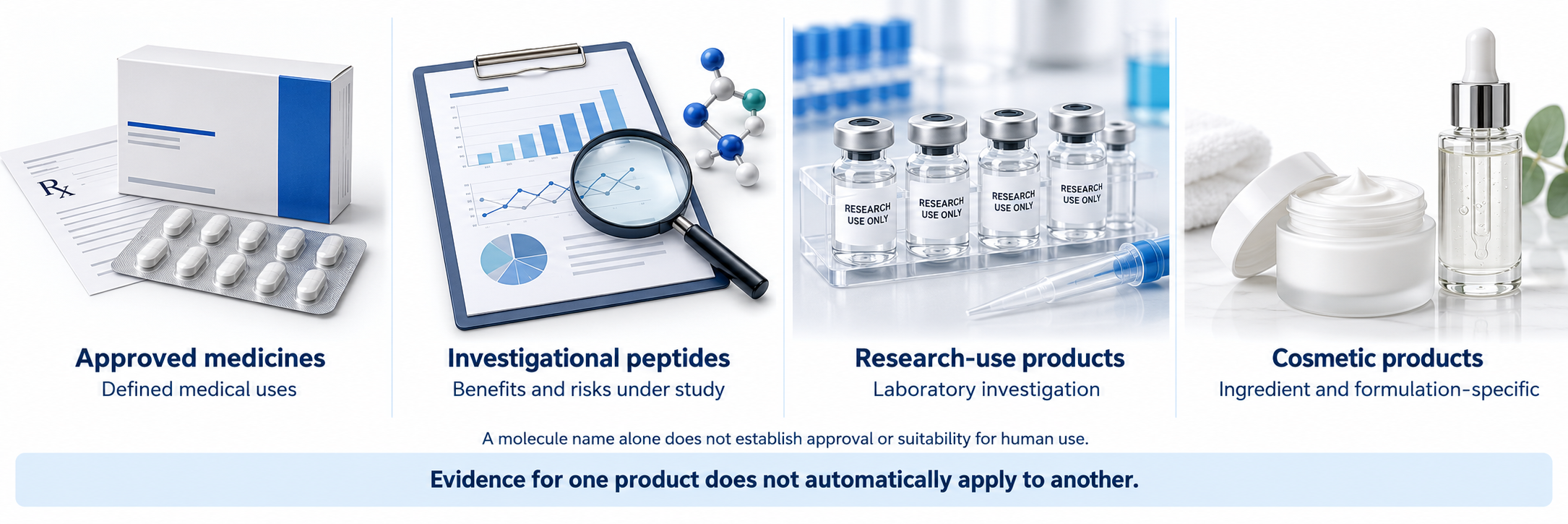
Understanding Peptide Product Types
The word “peptide” can appear on products with very different purposes.
| Product type | What it means |
|---|---|
| Approved peptide medicines | Specific drug products reviewed for defined medical uses |
| Investigational peptides | Compounds being studied, with benefits and risks that may remain uncertain |
| Research-use products | Materials intended for laboratory investigation |
| Cosmetic products | Finished products that need to be evaluated according to their ingredients, formulation, and intended use |
A molecule’s name alone does not tell you whether a particular product is approved or suitable for human use.
Evidence for one product should not automatically be transferred to another.
Explore NovaCyBio’s Research Catalog
NovaCyBio’s catalog includes individual research products, multi-component blends, other research compounds, and accessories.
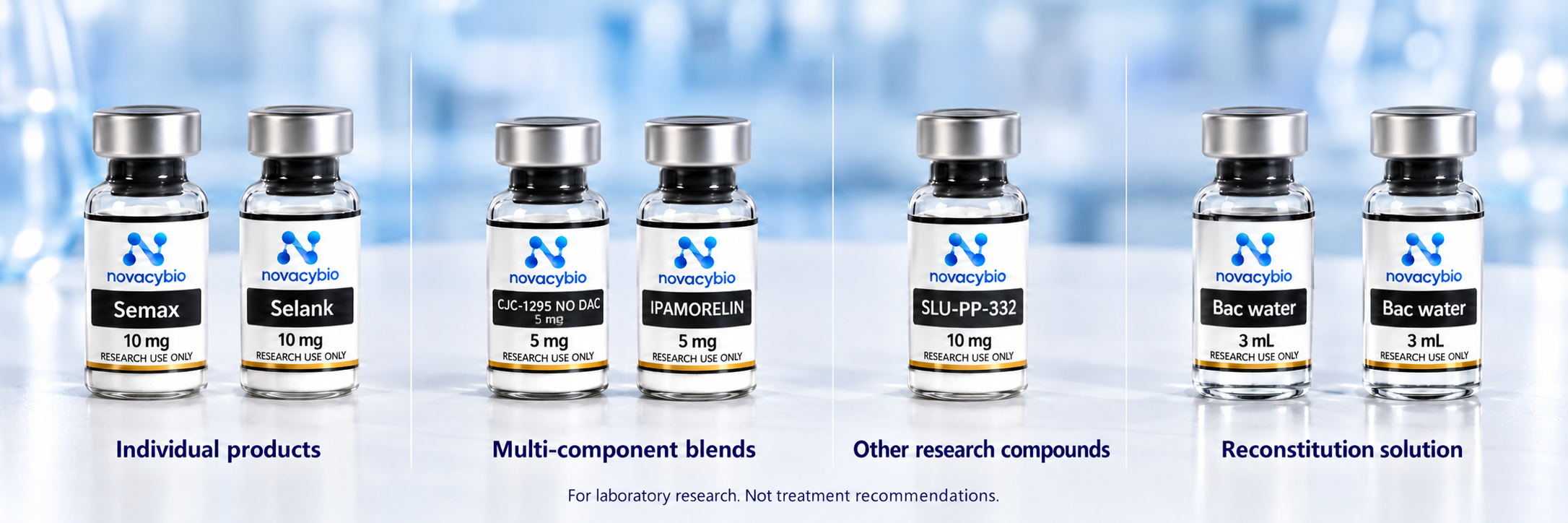
The examples below provide starting points for browsing the collection. They are not recommendations for treating symptoms.
Individual Research Products
Browse individual listings to review the named material and its available product information:
- BPC-157 research product
- MOTS-C research product
- KPV research product
- Semax research product
- Selank research product
For a laboratory project, compare the exact product specification with the material required by the study.
Different Versions and Blends
Some listings have similar names but different compositions.
For example, CJC-1295 DAC and CJC-1295 No DAC should be checked individually. Blends containing several components also need their own evaluation.
Before selecting a blend, review the identity and quantity of each component, together with the available documentation.
Other Research Compounds
The catalog also includes products such as NAD+, Vitamin B12, 5-amino-1mq, and SLU-PP-332.
Their presence in the same store does not make them all peptides. Check each product’s identity and intended laboratory use.
How to Evaluate Peptide Claims

Was It Studied in People?
Laboratory and animal studies help scientists investigate ideas. They do not automatically show that the same result occurs in people.
When a claim concerns a human health benefit, look for relevant human research.
Was the Same Product Studied?
Research on a prescription medicine does not automatically support a claim about a different vial, blend, cream, or supplement.
The ingredient, formulation, and intended use matter.
Does the Claim Promise Too Much?
A product described as the answer to many unrelated problems deserves careful scrutiny.
Testimonials and before-and-after photos cannot establish how reliably something works or what risks other people might face.
Are the Uncertainties Explained?
Useful information explains both the findings and their limits.
Look for a clear distinction between established evidence, early research, and personal opinion.
Are Peptides Safe?

here is no single answer for every peptide.
Safety depends on the molecule, the product, how it is used, and the person exposed to it.
“Natural” does not mean risk-free. The fact that the body makes a substance does not establish that using a manufactured version is safe.
FDA has raised concerns about unapproved peptide-related products sold online. Research-use materials should not be treated as substitutes for prescribed medicines.
If you are seeking help with a symptom or medical condition, a licensed healthcare professional can explain treatment options and the evidence behind them.
Frequently Asked Questions
What Is a Peptide in Simple Terms?
A peptide is a short chain of amino acids. Some act as messengers in the body, while others are studied for scientific or medical purposes.
What Are Peptides Used For?
Their uses depend on the molecule and product. Peptides are found in biological research, certain prescription medicines, and some cosmetic products.
Are All Peptides the Same?
No. Different peptides can have very different functions, evidence, and risks.
Are All Products in a Peptide Store Peptides?
No. A store may also offer vitamins, other research compounds, blends, and accessories.
Does “Research Use Only” Mean Safe to Try?
No. It describes an intended laboratory use. It does not establish suitability for personal use.
Does High Purity Mean a Product Is Safe?
No. Purity alone does not establish effectiveness, approval for medical use, or safety for a person.
Where to Go Next
Start with three questions: What is the molecule? What evidence supports the claim? What is this particular product intended for?
For laboratory investigation, explore NovaCyBio’s research catalog, review individual specifications, and request relevant batch documentation before selecting a material.
NovaCyBio’s research products are intended for laboratory research, not for treating symptoms or medical conditions.


References
- National Human Genome Research Institute. Peptide.
- U.S. Food and Drug Administration. FDA’s Concerns with Unapproved GLP-1 Drugs Used for Weight Loss.