
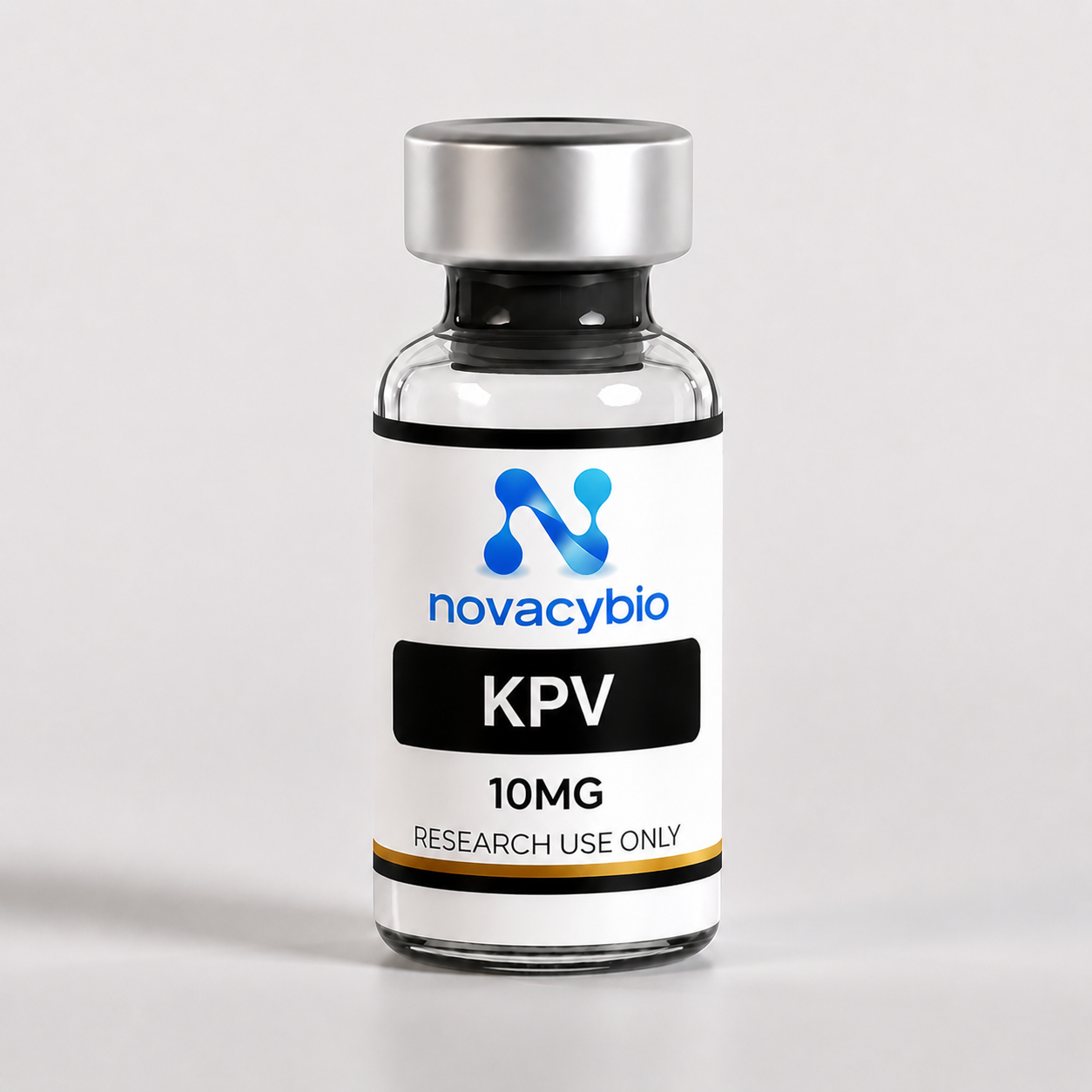
KPV
原价为:$69.99。$59.99当前价格为:$59.99。
High-Purity KPV Peptide (Lys-Pro-Val) | ≥99% HPLC Verified Research Compound
KPV Peptide (Lys-Pro-Val) Research Compound
High-Purity Lyophilized Tripeptide for In Vitro Research Applications
1. What is KPV? (Identity Positioning)
KPV (Lys-Pro-Val) is a synthetic tripeptide consisting of three amino acids: Lysine (Lys), Proline (Pro), and Valine (Val). It represents the C-terminal fragment of α-melanocyte-stimulating hormone (α-MSH 11–13), a naturally occurring peptide sequence studied in molecular biology and immunology research.
Within peptide research, KPV is primarily investigated as a small bioactive peptide fragment involved in studies related to inflammatory signaling pathways, immune response modulation, and cellular communication mechanisms.
Unlike longer peptide hormones, KPV is a minimal peptide sequence that allows researchers to examine specific biological interactions while maintaining a simplified molecular structure.
Product Identity:
-
Name: KPV Peptide
-
Sequence: Lys-Pro-Val
-
Peptide Type: Synthetic tripeptide research compound
-
Category: Anti-inflammatory pathway research peptide
-
Format: Lyophilized white powder
-
Purity: ≥99% (HPLC Verified)
-
CAS Number: 67727-97-3
2. Peptide Category Positioning
KPV belongs to the category of:
Short-Chain Bioactive Peptides
Research classification:
-
α-MSH-derived peptide fragment
-
Synthetic tripeptide
-
Inflammatory pathway research peptide
-
Immune signaling research compound
-
Cellular response modulation peptide
Compared with larger peptide molecules, short-chain peptides such as KPV are frequently studied because their compact structure enables researchers to investigate:
-
peptide-receptor interactions
-
molecular signaling pathways
-
structure-function relationships
-
inflammatory mediator regulation
3. Research Logic (R&D Background)
The research interest surrounding KPV originates from the biological activity of α-MSH, a melanocortin peptide involved in multiple physiological signaling pathways.
Researchers isolated the C-terminal tripeptide sequence Lys-Pro-Val to investigate whether this minimal peptide fragment retains specific molecular activities associated with α-MSH-related pathways.
Current research logic focuses on:
1. Peptide Structure Investigation
Understanding how a short amino acid sequence can influence cellular signaling mechanisms.
2. Inflammatory Pathway Research
Exploring interactions between KPV and pathways associated with inflammatory mediator expression.
3. Immune Response Studies
Investigating potential effects on immune cell signaling and cytokine-related mechanisms.
4. Molecular Mechanism Studies
Using KPV as a simplified model compound for studying peptide-mediated biological communication.
4. Research Findings
Inflammatory Signaling Research
Published research has investigated KPV as an α-MSH-derived peptide fragment with potential activity in inflammation-related models.
Studies have explored KPV in relation to:
-
inflammatory mediator regulation
-
cytokine expression pathways
-
immune cell response mechanisms
-
epithelial and tissue inflammation models
Research models have examined KPV interactions with pathways including:
-
NF-κB signaling pathways
-
inflammatory cytokine networks
-
macrophage-associated inflammatory responses
Gastrointestinal Inflammation Research
KPV has been studied in experimental models related to intestinal inflammation.
Research areas include:
-
intestinal epithelial cell responses
-
inflammatory bowel disease research models
-
mucosal immune signaling
-
inflammatory mediator regulation
These studies provide a foundation for further investigation into peptide-based approaches for understanding inflammatory mechanisms.
Cellular and Molecular Research
Additional research applications include:
-
cellular signaling studies
-
peptide interaction screening
-
inflammatory pathway analysis
-
molecular biology experiments
5. Research Applications
KPV peptide is supplied for laboratory research applications including:
Inflammatory Pathway Studies
Researchers investigate KPV in models involving:
-
inflammatory signaling cascades
-
cytokine expression studies
-
immune response mechanisms
Cell Culture Research
Potential laboratory applications include:
-
cell signaling experiments
-
cellular response analysis
-
molecular pathway studies
Immunology Research
Used as a research compound for studying:
-
immune cell communication
-
inflammatory mediator pathways
-
immune modulation mechanisms
Peptide Research & Development
Applications include:
-
peptide structure-function studies
-
bioactive peptide screening
-
comparative peptide research
6. Safety Profile
KPV is provided as a research-grade peptide compound intended exclusively for laboratory investigation.
Available preclinical research has explored KPV-related mechanisms in experimental systems; however, comprehensive human safety, pharmacokinetic, and clinical evaluation data are not established.
Researchers should evaluate:
-
experimental suitability
-
laboratory handling requirements
-
stability conditions
-
study-specific safety protocols
Important considerations:
-
Research findings from laboratory models should not be interpreted as clinical evidence.
-
Safety evaluation depends on experimental design and application conditions.
7. Final Product Positioning
Premium Research-Grade KPV Peptide
This KPV peptide product is positioned as a:
High-purity synthetic tripeptide research compound designed for academic, biotechnology, and pharmaceutical research laboratories.
Key product advantages:
✓ ≥99% purity verified by HPLC
✓ Defined Lys-Pro-Val sequence
✓ Lyophilized formulation for research handling
✓ Batch-specific quality documentation
✓ Suitable for molecular and cellular research workflows
Target customers:
-
University research laboratories
-
Biotechnology companies
-
Pharmaceutical R&D departments
-
Peptide research organizations
-
Contract research organizations (CROs)
8. Quality Documentation
Certificate of Analysis (COA)
Each batch can be supported by documentation including:
-
Product identification
-
Batch number
-
Manufacturing date
-
Purity specification
-
Analytical testing results
HPLC Report
High-performance liquid chromatography (HPLC) analysis provides:
-
purity verification
-
chromatographic profile
-
batch consistency evaluation
Mass Spectrometry
Mass spectrometry confirmation supports:
-
molecular weight verification
-
peptide identity confirmation
-
sequence validation
Batch Documentation
Available batch records may include:
-
manufacturing information
-
quality control records
-
analytical test documentation
-
storage recommendations
9. Storage Information
Lyophilized Peptide Storage
Recommended storage:
-
Store lyophilized peptide at −20°C
-
Protect from moisture and direct light
-
Keep container tightly sealed
Reconstituted Solution Storage
After reconstitution:
-
Store according to laboratory protocol
-
Refrigeration conditions may be recommended
-
Avoid repeated freeze-thaw cycles
Proper storage helps maintain:
-
peptide stability
-
molecular integrity
-
analytical consistency
10. Research Disclaimer
For research use only.
Not intended for human consumption.
Not intended for clinical or diagnostic use.
This product is supplied exclusively as a laboratory research compound. It is not approved as a drug, dietary supplement, therapeutic product, or medical treatment.
Researchers are responsible for ensuring appropriate handling, storage, and use according to applicable laboratory regulations.
11. Frequently Asked Questions (FAQ)
1. What is KPV peptide used for in research?
KPV peptide is primarily studied in laboratory research involving inflammatory signaling pathways, immune response mechanisms, and cellular communication studies.
2. What type of peptide is KPV?
KPV is a synthetic tripeptide consisting of Lys-Pro-Val and is classified as an α-MSH-derived peptide research compound.
3. What is the purity of this KPV peptide?
This research-grade KPV peptide is supplied with ≥99% purity verified by HPLC analysis.
4. Does KPV peptide include quality documentation?
Yes. Research peptide batches may include documentation such as COA, HPLC analysis reports, mass spectrometry confirmation, and batch records.
5. How should KPV peptide be stored?
Lyophilized KPV peptide should generally be stored at −20°C and protected from moisture, heat, and light.
6. Is KPV peptide approved for human use?
No. KPV peptide products supplied by research peptide providers are intended for laboratory research only and are not approved for human consumption or clinical applications.
7. What analytical methods are used for KPV peptide verification?
Common analytical methods include HPLC purity testing and mass spectrometry analysis for molecular identity confirmation.
8. Who typically purchases KPV peptide?
Typical customers include research institutions, biotechnology companies, pharmaceutical R&D teams, universities, and contract research organizations requiring high-quality peptide compounds.
相关产品
评价
目前还没有评价