
Blog
Research Peptides vs. FDA-Approved Peptide Medicines: Safety, Evidence, and U.S. Legal Status


Peptides appear in discussions about weight loss, skincare, recovery, and healthy aging. But research peptides and FDA-approved peptide medicines are different product categories, even when their labels contain familiar compound names.
That distinction matters when evaluating peptide therapy claims. A published study, a purity certificate, and FDA approval each answer different questions. None should be treated as a substitute for the others.
This guide explains those differences, what safety and legal claims mean in the United States, and which documents laboratory buyers should review.
Key takeaways
- “Peptide” describes a type of molecule, not an approval status.
- Research products are not substitutes for approved medicines.
- Safety depends on the specific product and how it is used.
- A COA can support analytical findings, but cannot establish clinical effectiveness.
- U.S. regulatory information should be checked against current official sources.
A Quick Definition: What Is a Peptide?
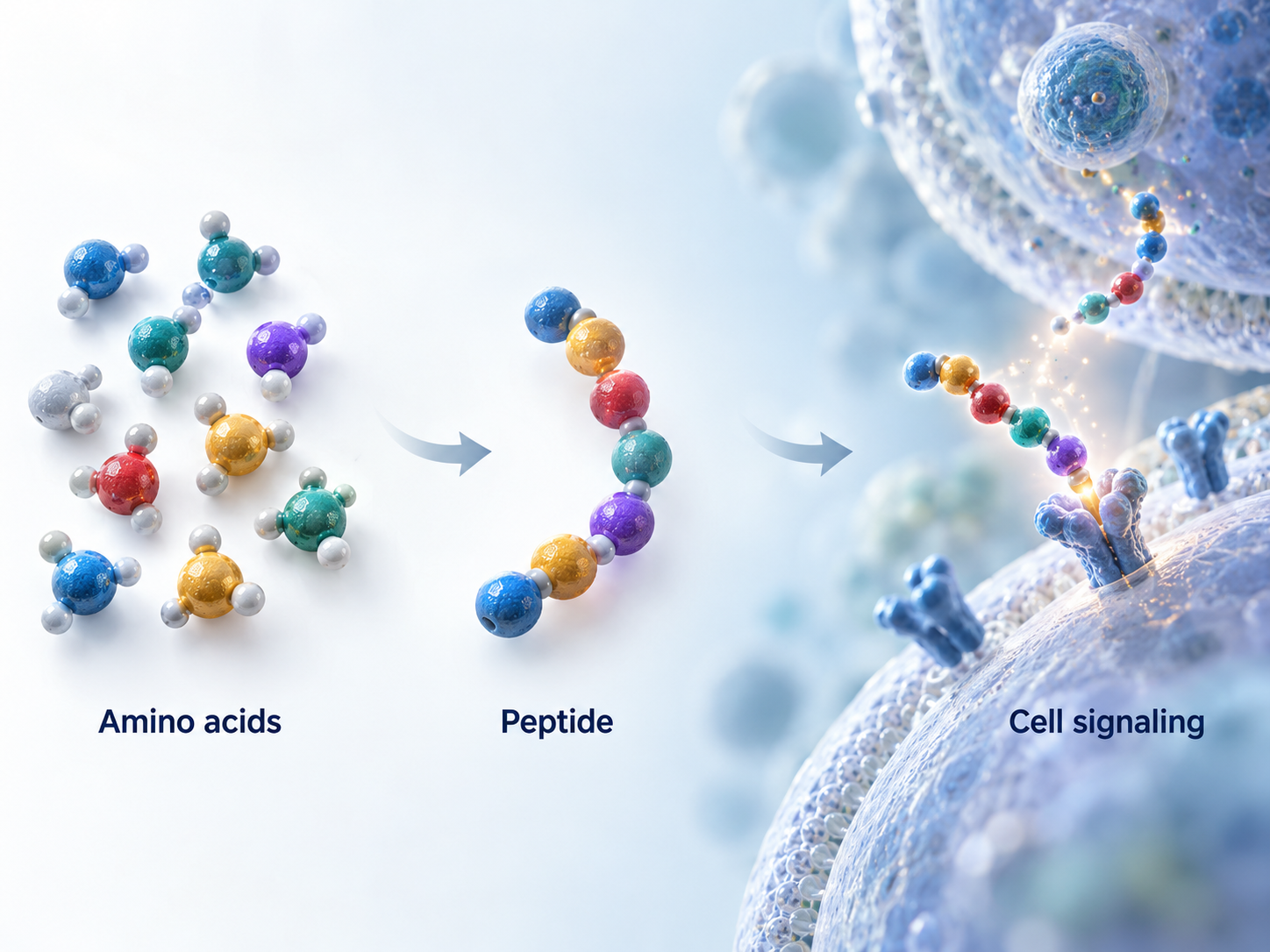
A peptide is a short chain of amino acids connected by chemical links called peptide bonds. Amino acids are also the building blocks of proteins. 1
Some peptides occur naturally in the body and help cells communicate. Others are developed or studied for particular scientific purposes.
However, sharing the same broad molecular category does not give different peptides the same effects, risks, or legal status.
What Are Research Peptides?
Research peptides are materials supplied for scientific investigation. Depending on the experiment, researchers may use them to examine molecular interactions, cell responses, or biological pathways.
The label “research use only” describes an intended research context. It does not demonstrate that a product is suitable for personal treatment.
It is also important to distinguish a research supplier’s product from an investigational medicine used in a clinical trial. A trial evaluates a defined formulation under a specific protocol. A separately sold vial with a similar name is not automatically the same material.

The product name is the beginning of an evaluation—not the conclusion.
For laboratory procurement, review NovaCyBio’s research catalog and request the specification and batch documentation for the material under consideration.
FDA-Approved Peptide Medicines vs. Research Peptides
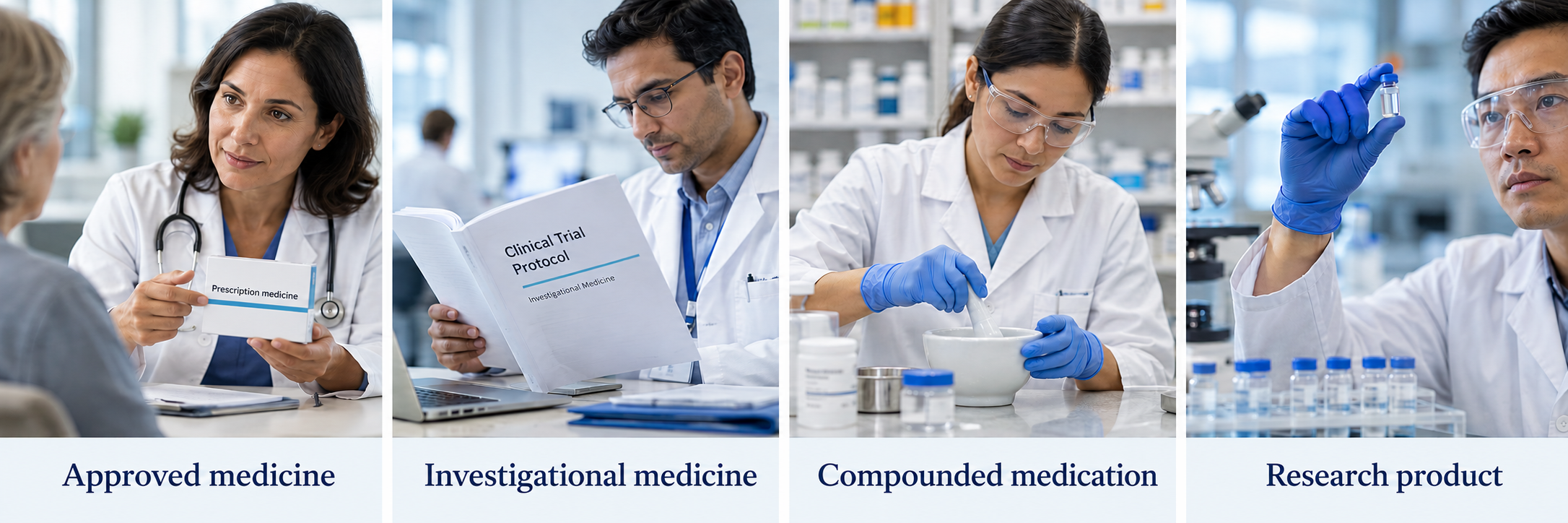
The most useful comparison concerns the particular product, its intended purpose, and the evidence supporting it.
| Category | Intended context | Evidence to examine | Important distinction |
|---|---|---|---|
| FDA-approved peptide medicine | Defined medical uses | Approved labeling and clinical evidence | Approval concerns a specific drug product |
| Investigational medicine | A defined research protocol | Trial registration, methods, and results | Trial participation differs from buying a research vial |
| Compounded medication | Particular patient needs under applicable requirements | Prescription context, pharmacy information, and formulation | Compounded drugs are not FDA approved |
| Laboratory research product | Scientific investigation | Identity, specifications, and batch documentation | Analytical results do not establish treatment benefits |
FDA explains that unapproved products do not undergo its premarket review for safety, effectiveness, and quality. It also distinguishes compounded medications from approved medicines. 2
A familiar ingredient name therefore cannot establish that two products are equivalent.
What Does “Peptide Therapy” Actually Mean?
“Peptide therapy” is a broad expression used in medical and wellness discussions. On its own, it does not identify the product, its approval status, or the strength of the evidence.
When you encounter the phrase, ask:
- Which exact medicine or compound is being discussed?
- What condition or outcome is it intended to address?
- Was that particular formulation studied?
- Does the claim refer to an approved use, an investigational use, or an unsupported promise?

An explanation that answers these questions is more informative than a general statement about the benefits of peptides.
Are Peptides Safe?

There is no single safety answer for every peptide.
A useful assessment considers the molecule, formulation, product quality, intended use, and the individual’s health circumstances.
An approved medicine can still have side effects and precautions. Conversely, limited safety information about an experimental compound should not be interpreted as evidence that it has few risks.
Peptides Side Effects: Look for Product-Specific Information
Searches for “peptides side effects” often combine unrelated products.
Instead, look for information about the exact medicine or compound. Check which population was studied, how long participants were followed, and which adverse effects were assessed.
“Nothing serious was reported” is not the same as “long-term safety has been established.”

Peptide Injections: Why Formulation and Sterility Matter
Peptide injections introduce additional product-quality questions.
A test confirming molecular identity or chromatographic purity does not establish sterility. Nor does it show that a formulation is appropriate for injection.
FDA has identified contamination and dosing-related concerns involving unapproved GLP-1 products. 2
For personal medical care, obtain product-specific advice from a licensed healthcare professional. This guide does not provide injection instructions, reconstitution methods, or dosing schedules.
Are Peptides Legal in the United States?

“Are peptides legal?” is too broad for a simple yes-or-no answer.
A meaningful assessment identifies the specific product, intended use, and activity involved—such as prescribing, marketing, supplying, importing, or conducting research.
A Research Label Is Not Automatic Authorization
FDA has warned sellers whose products were labeled for research but marketed for human use. A disclaimer does not override the actual intended use shown by the surrounding claims and sales practices. 2
Research, Approval, and Compounding Are Different Questions
These statements should not be confused:
- A compound has appeared in a study.
- A particular drug product has received approval.
- A substance meets the requirements for a particular compounding pathway.
None automatically establishes the others.
This section focuses on U.S. regulatory distinctions. Other jurisdictions have their own requirements, and legal conclusions need to match the particular circumstances.
Retatrutide Peptide and Other GLP-1-Related Examples
Discussions about peptides for weight loss provide a useful example of how research and approval can be confused.
GLP-1 stands for glucagon-like peptide-1, a hormone involved in metabolic signaling. However, “GLP-1 peptide” is not enough information to identify a product’s regulatory status.

Retatrutide Peptide: What Does a Trial Establish?
Retatrutide, sometimes called “reta peptide,” has been studied as an agonist of three receptors: GIP, GLP-1, and glucagon.
A published phase 2 obesity trial evaluated a defined investigational formulation and reported outcomes under specified conditions. 3
Those results describe that study. They do not validate the identity, quality, or clinical suitability of a research product sold elsewhere.
What Is Its Current U.S. Status?
As checked on October 21, 2026, FDA states that retatrutide is not a component of an approved drug and cannot be used in compounding under federal law. 2
Regulatory status can change. Readers should consult the current official information rather than rely on an undated product page or social-media post.
For laboratory buyers: the Retatrutide research product listing is a starting point for checking the supplied material’s specifications. It is not evidence of approval or suitability for personal treatment.
How to Evaluate Peptide Claims and Batch Documents

For general readers, start with the evidence behind the claimed benefit. For research procurement, also examine the material being supplied.
1. Match the Evidence to the Claim
Ask what the study actually examined:
- Cells in a laboratory?
- Animals?
- A small exploratory human study?
- A controlled clinical trial?
Then check the outcome. A change in a laboratory marker does not automatically demonstrate better symptoms, recovery, or long-term health.
2. Match the Study to the Product
Compare the molecule, formulation, route, and composition.
A paper about one ingredient cannot establish how a multi-component blend performs. Likewise, results from a topical formulation cannot be assumed to apply to an injectable or laboratory material.
3. Look Beyond “High Purity Research Peptides”
The phrase high purity research peptides needs supporting analytical information.
Purity, identity, and content are different measurements. Water, counterions, and the method used can affect how results should be interpreted. Peptide quality assessments therefore require more than a single percentage. 4
4. Request Documents for the Actual Batch
| Document or detail | What to check |
|---|---|
| Product specification | Exact identity, chemical form, quantity, and acceptance criteria |
| Batch-specific COA | Lot number matching the material being supplied |
| Supporting analytical results | Methods and data relevant to identity, purity, and content |
| Independent testing, when claimed | Laboratory identity, tested sample, date, and batch connection |
| Blend information | Identity and quantity of every component |
| Handling information | Storage conditions and available stability data |
Independent testing is useful only within its actual scope. A laboratory report should make clear what was tested and which conclusions the results support.
No analytical certificate can substitute for clinical evidence or regulatory approval.

Frequently Asked Questions

What Are Peptides?
Peptides are short chains of amino acids. Some act as biological messengers, while others are investigated for scientific or medical purposes.
What Do Peptides Do?
Different peptides have different functions. Many interact with biological targets involved in communication between cells. The word alone does not establish a particular benefit.
Are Peptides Safe?
Safety depends on the specific molecule, formulation, quality, use, and individual circumstances. Evidence should be evaluated product by product.
Are Peptides Legal?
Their status depends on the particular product, intended use, and activity involved. “Research use only” does not authorize marketing an unapproved product for human treatment.
What Is the Difference Between Peptide Therapy and Research Peptides?
“Peptide therapy” describes a proposed or actual treatment context. Research peptides are laboratory materials. Neither phrase, by itself, establishes approval or clinical suitability.
Does a COA Mean a Product Is FDA Approved?
No. A COA reports defined analytical findings. It is not an approval document.
Check the Product, the Evidence, and the Purpose

Understanding peptides requires separating three questions:
What is the material? What evidence supports the claim? What is this particular product intended and authorized for?
For personal treatment, discuss medical options with a licensed healthcare professional.
For laboratory procurement, review the specification and batch documentation against the experiment’s requirements. Keep those purchasing decisions separate from claims about treating symptoms.
References
- National Human Genome Research Institute. Peptide.
- U.S. Food and Drug Administration. FDA’s Concerns with Unapproved GLP-1 Drugs Used for Weight Loss. Regulatory information checked October 21, 2026.
- Jastreboff AM, et al. Triple-Hormone-Receptor Agonist Retatrutide for Obesity—A Phase 2 Trial. New England Journal of Medicine. 2023.
- Duncan K. CMC Regulatory Experiences and Expectations for Peptides. 2024 conference presentation. The presentation reflects the author’s views and should not be treated as FDA policy.