
Blog
AOD-9604 and Fat Metabolism: Is Releasing Fat the Same as Burning It?



The AOD 9604 peptide has attracted interest for more than its ability to influence fat release. Animal experiments have also reported increased fat oxidation, changes in body fat, and reduced body-weight gain—findings that connect several stages of fat metabolism. [1], [2].
These observations explain why AOD-9604 remains a topic of interest in metabolic research and development.
They also lead to a useful question: once stored fat is released, where does it go?
The answer helps clarify the peptide’s potential functions, the significance of its experimental results, and the difference between changing one metabolic step and reducing body fat over time.
What Makes the AOD-9604 Peptide Distinctive?
The AOD9604 peptide is a synthetic peptide containing 16 amino acid residues. Its design is based on the C-terminal region of human growth hormone, comprising residues 177–191 with an additional tyrosine at the beginning.
Its development explored whether a short peptide could retain particular effects on lipid metabolism while acting differently from the complete hormone. [3].
Often shortened to AOD peptide, the compound therefore has a specific identity and development background. It should be distinguished from full-length growth hormone and other growth hormone fragments.
One experimental study found that AOD-9604 did not compete for the growth hormone receptor or stimulate proliferation in the receptor-based cell system tested. This supports investigating its metabolic activity separately from conventional growth hormone signaling. [1].
Three Metabolic Effects That Make AOD-9604 Worth Studying
1. Increased Fat Mobilization
Fat mobilization makes stored energy available by breaking down triglycerides into fatty acids and glycerol.
AOD-9604 experiments have reported increased lipolytic activity in adipose tissue. In an obese Zucker-rat study, researchers observed this change alongside reduced body-weight gain during 19 days of oral treatment.
The treated animals gained approximately 15.8 g, compared with 35.6 g in controls. Both groups gained weight, but accumulation was substantially lower in the treated group.
Why this matters: The result connects a change in fat-tissue activity with a measurable whole-animal outcome. It provides a basis for investigating how increased fat mobilization affects longer-term energy storage. [4].
2. Increased Fat Oxidation
Fat oxidation is the use of fatty acids in energy-producing pathways.
In a 14-day study, researchers assessed AOD-9604 in obese and lean mice using controlled continuous delivery. In the obese animals, treatment was associated with increased plasma glycerol—an index of lipolysis—and increased fat oxidation.
Why this matters: The researchers observed a change in fat utilization as well as a breakdown-related marker. That makes the finding more informative than a general statement that the peptide “releases fat.” [1].
3. Changes in Body Fat and Lipolytic Responsiveness
Another mouse study reported reductions in body weight and body fat after repeated AOD-9604 administration.
Researchers also observed increased expression of beta-3 adrenergic receptor RNA. These receptors participate in fat-cell responses to metabolic signals.
Experiments in receptor-knockout mice showed that immediate metabolic responses and longer-term effects did not behave identically.
Why this matters: The findings suggest that AOD-9604’s activity involves more than a simple, immediate release of stored fat. They provide leads for investigating how fat-cell responsiveness relates to tissue changes over time. [2].

Potential Functions at a Glance
| Potential function | Positive experimental observation | What makes it interesting |
|---|---|---|
| Fat mobilization | Increased lipolytic activity in adipose tissue | Links the peptide to the release of stored energy |
| Fat utilization | Increased fat oxidation in obese mice | Extends the findings beyond fat release |
| Changes in fat accumulation | Reduced weight gain or body fat in particular rodent models | Connects metabolic activity with whole-animal outcomes |
These are distinct findings from preclinical experiments. Together, they explain the interest in AOD-9604’s metabolic profile.
Once Fat Is Released, Where Does It Go?
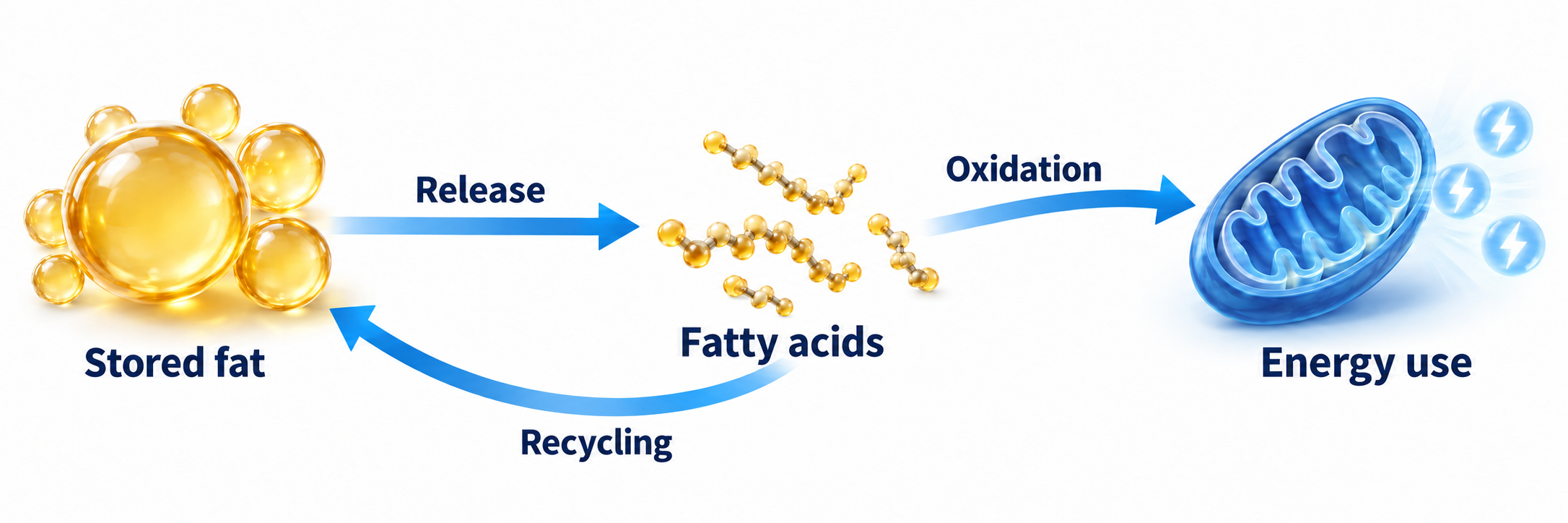
Understanding the sequence helps put those potential functions into context.
Release: Making Fatty Acids Available
During lipolysis, stored triglycerides are broken down. Fatty acids become available for transport and use by tissues.
Oxidation: Using Fatty Acids for Energy
Some fatty acids enter energy-producing pathways. Researchers assess this process separately from the rate at which fat is released.
Recycling: Returning Fatty Acids to Storage
Other fatty acids are rebuilt into triglycerides through re-esterification.
Human metabolic research has directly demonstrated that release and recycling can occur together. [5].
A simplified view is:
Stored fat → breakdown → fatty acids → energy production OR rebuilding into storage
This explains why “more fat released” and “less body fat” are related questions, but different measurements.
How the Experimental Effects Fit Together
The strongest reason to examine AOD-9604 is the combination of findings across several metabolic endpoints.
In the published animal work, investigators measured changes involving:
- Fat-tissue breakdown activity.
- Glycerol and other metabolic markers.
- Fat oxidation.
- Body-weight gain or fat mass.
- Fat-cell signaling responsiveness.
That gives researchers several ways to investigate the compound’s activity.
It also helps frame product evaluation around specific questions. A fat-mobilization experiment examines release; an oxidation experiment examines utilization; a body-composition experiment examines the accumulated outcome.
A change in one measurement does not predict the magnitude of every other change. Species, formulation, exposure, duration, food intake, and activity all influence the result.

Human Research: Where the Evidence Stands
Early human studies provided signals that encouraged further development. A 12-week study involving 300 adults with obesity reported favorable weight and waist findings in a conference abstract, although the FDA later noted limited methodological information and small differences between groups.
The larger OPTIONS trial randomized 502 adults with obesity to oral AOD-9604 or placebo within a 24-week program. It did not demonstrate significantly greater weight loss on its primary endpoint, assessed at 12 weeks. [6].
These results define an important boundary: positive metabolic findings in animals have not established reliable human weight-loss effectiveness. A different formulation, delivery route, or combination requires direct evidence rather than an assumption of improved performance.

Why AOD-9604 Appears Alongside GLP-1-Based Compounds
AOD-9604 and GLP-1-based compounds appear in the same commercial and scientific conversations because they concern metabolism and body weight.
Their research emphasis differs. AOD-9604’s experimental literature focuses on lipid handling, while GLP-1 receptor agonist studies include direct measurements of appetite, food intake, and eating behavior.
For example, a randomized semaglutide study investigated energy intake alongside body weight and appetite-related outcomes. [7].
These differences create questions for comparative research. They do not establish that combining the compounds improves outcomes. No controlled human trial demonstrating an added benefit from an AOD-9604/GLP-1 combination was identified for this article.

Safety and Product Context
A developer-associated report summarizing human AOD-9604 trials described generally favorable tolerability, no significant IGF-1 increase, and no significant adverse changes in the carbohydrate-metabolism measurements discussed. Those observations apply to the studied formulations and conditions. [3].
The FDA has highlighted incomplete information on long-term safety and concerns involving peptide impurities, aggregation, and immunogenicity. AOD-9604 is not a component of an FDA-approved drug. [6].
Published findings should therefore be matched to the actual material and intended application when evaluating product specifications and development opportunities.

Frequently Asked Questions
What Are the Main Potential AOD 9604 Benefits?
The main positive experimental findings involve increased fat mobilization, increased fat oxidation, and changes in weight gain or body fat in rodent models.
These findings give the compound a defined metabolic profile worth investigating.
Is Releasing Fat the Same as Burning It?
No. Release makes fatty acids available. Oxidation uses them for energy. Some released fatty acids can also return to storage.
Is AOD-9604 the Same as Human Growth Hormone?
No. It is a modified short peptide based on part of the growth hormone sequence. Its experimental activity should be evaluated independently of full-length growth hormone.
Does AOD-9604 Specifically Target Belly Fat?
The evidence reviewed here does not establish targeted abdominal fat reduction in people. Regional fat changes require direct measurements of the relevant tissue.
Why Is the Distinction Between Weight Gain and Weight Loss Important?
An animal can gain less weight than a control while still becoming heavier. Reduced weight gain is a meaningful experimental result, but it describes a different outcome from losing existing body weight.
What Makes AOD-9604 Worth Further Investigation?
Its appeal lies in measured effects at several stages of lipid metabolism and experimental differences from full-length growth hormone. These characteristics provide specific questions for metabolic research and product development.

Following Fat From Storage to Use
AOD-9604’s experimental profile brings together fat mobilization, fat oxidation, and changes in fat accumulation in particular animal models.
Those observations explain why the compound continues to attract attention. Its value is clearest when each potential function is connected to the result actually measured: releasing stored energy, using fatty acids, or changing tissue accumulation over time.
Explore Novacybio’s AOD-9604 product specifications. Contact us for bulk purchasing, raw material supply inquiries, and business procurement.
References
- Heffernan MA, et al. Increase of fat oxidation and weight loss in obese mice caused by chronic treatment with human growth hormone or a modified C-terminal fragment. International Journal of Obesity and Related Metabolic Disorders. 2001;25(10):1442–1449. DOI: 10.1038/sj.ijo.0801740.
- Heffernan M, et al. The effects of human GH and its lipolytic fragment (AOD9604) on lipid metabolism following chronic treatment in obese mice and beta(3)-AR knock-out mice. Endocrinology. 2001;142(12):5182–5189. DOI: 10.1210/endo.142.12.8522.
- Stier H, Vos E, Kenley D. Safety and Tolerability of the Hexadecapeptide AOD9604 in Humans. Journal of Endocrinology and Metabolism. 2013;3(1–2):7–15. DOI: 10.4021/jem157w.
- Ng FM, et al. Metabolic Studies of a Synthetic Lipolytic Domain (AOD9604) of Human Growth Hormone. Hormone Research. 2000;53(6):274–278. DOI: 10.1159/000053183.
- Wolfe RR, Klein S, Carraro F, Weber JM. Role of triglyceride-fatty acid cycle in controlling fat metabolism in humans during and after exercise. American Journal of Physiology. 1990;258(2 Pt 1):E382–E389. DOI: 10.1152/ajpendo.1990.258.2.E382.
- U.S. Food and Drug Administration. FDA Briefing Document: Evaluation of AOD-9604-related Bulk Drug Substances. Pharmacy Compounding Advisory Committee meeting, December 4, 2024.
- Blundell J, et al. Effects of once-weekly semaglutide on appetite, energy intake, control of eating, food preference and body weight in subjects with obesity. Diabetes, Obesity and Metabolism. 2017;19(9):1242–1251. DOI: 10.1111/dom.12932.