
Blog
Tesamorelin Peptide: What a 26-Week Visceral Fat Trial Revealed



In a 26-week clinical trial, researchers used CT scans to track something a bathroom scale could not identify: changes in fat stored deep inside the abdomen.
The findings helped establish the tesamorelin peptide as a subject of clinical interest in visceral-fat reduction. They also raised further questions about liver fat, lean tissue, and the relationship between body composition and body weight. Original clinical trial.
Following that research provides a useful way to understand tesamorelin. Rather than treating every form of abdominal fat as the same, the studies examined particular tissues and measured how they changed.
Here is what the pivotal trial found, what later research added, and why the differences between these outcomes matter.
Inside the 26-Week Trial
Who Participated?
The randomized, placebo-controlled study enrolled 412 adults with HIV and abdominal fat accumulation.
Its main outcome was the change in visceral adipose tissue, assessed by CT imaging over 26 weeks.
What Changed?
The reported mean percentage changes were:
| Group | Change in visceral fat at 26 weeks |
|---|---|
| Tesamorelin | 15.2% decrease |
| Placebo | 5.0% increase |
The separation between those reported changes was 20.2 percentage points. These numbers describe visceral fat—not total body-weight loss. Original trial results.
Why Was the Result Important?
The trial demonstrated a measurable reduction in an internal fat compartment in the studied population.
That gives the finding its value: researchers identified which tissue changed, rather than relying on appearance or weight alone. It also established a concrete clinical basis for further tesamorelin research.

Why Researchers Measured Visceral Fat
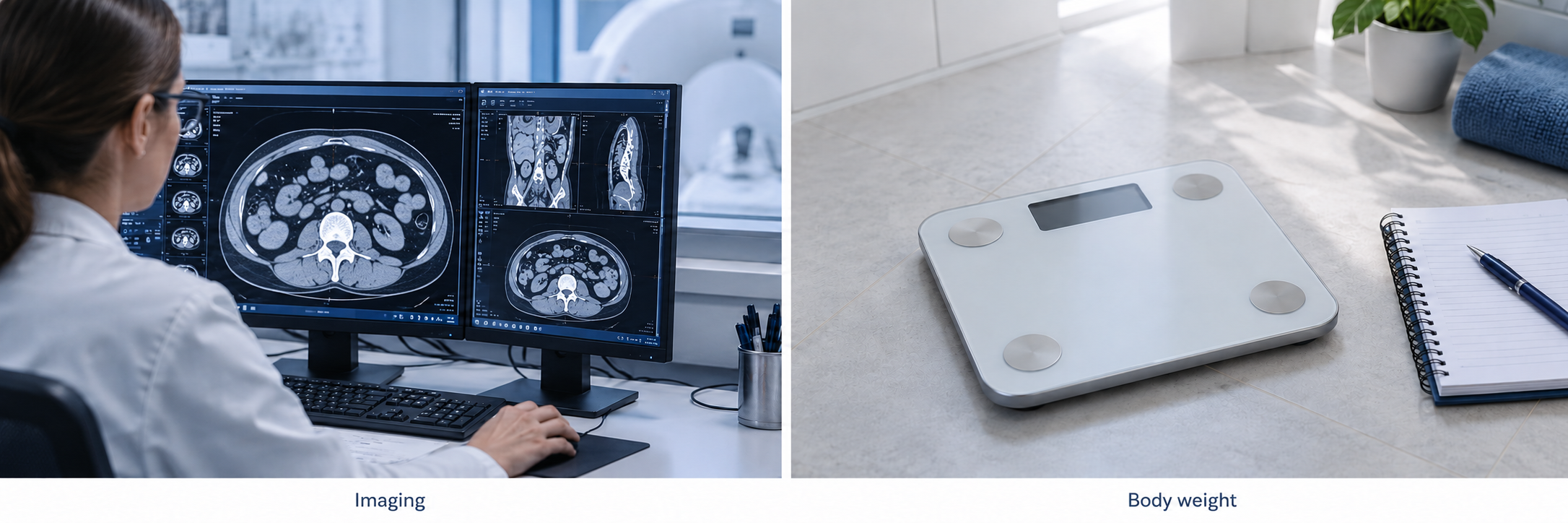
“Belly fat” is an everyday description that can conceal important biological differences.
Visceral Fat vs. Subcutaneous Fat
Visceral fat is located within the abdomen, around internal organs.
Subcutaneous fat sits beneath the skin. Much of the abdominal fat that can be pinched belongs to this compartment.
A change in one does not establish an equal change in the other.
Where Does Liver Fat Fit In?
Liver fat is another measurement altogether. It describes fat stored within liver tissue, rather than the surrounding abdominal fat compartment.
| Tissue or measurement | What it describes | How researchers may assess it |
|---|---|---|
| Visceral fat | Fat within the abdomen around organs | CT or MRI |
| Subcutaneous fat | Fat beneath the skin | CT, MRI, or other body-composition methods |
| Liver fat | Fat stored in liver tissue | Magnetic resonance spectroscopy or MRI-based methods |
| Body weight | Combined mass of fat, lean tissue, water, and other components | A scale |
Tesamorelin studies have measured abdominal and liver fat separately, allowing researchers to distinguish changes that body weight cannot explain. Clinical imaging study.
How Tesamorelin May Explain These Changes
A Signal for Growth Hormone Release
Tesamorelin is a synthetic analogue of growth hormone-releasing hormone, or GHRH.
An analogue resembles another molecule and produces a related biological response. In this case, tesamorelin acts on the signaling system that prompts the pituitary gland to release growth hormone.
It therefore differs from administering growth hormone directly.
The Growth Hormone–IGF-1 Pathway
The pathway can be summarized as:
Tesamorelin → pituitary GHRH receptor signaling → growth hormone release → changes in IGF-1 and downstream metabolic activity
IGF-1 means insulin-like growth factor 1. It is one measurable part of the hormonal response.
A human mechanistic study found that tesamorelin increased measures of endogenous growth hormone pulsatility and raised IGF-1. Human hormone-secretion study.
Why This Connects to Fat Research
Growth hormone signaling influences fat metabolism, providing a reason to investigate tissue-level changes.
However, the mechanism and the clinical finding answer different questions. Hormonal measurements help explain how tesamorelin acts; imaging determines whether a particular fat compartment actually changed.

What Later Studies Added: Liver Fat
A Six-Month Clinical Finding
A randomized trial involving 50 adults with HIV and abdominal fat accumulation investigated both visceral and liver fat.
Over six months, tesamorelin reduced visceral fat and produced a modest reduction in liver fat compared with placebo. Liver fat was assessed using magnetic resonance spectroscopy. Original six-month trial.
This expanded the research question from fat around abdominal organs to fat stored within the liver.
A Longer Trial in HIV-Associated Fatty Liver Disease
A subsequent randomized, double-blind trial enrolled 61 people with HIV and nonalcoholic fatty liver disease, using the terminology of the original publication.
After 12 months, tesamorelin produced a placebo-adjusted reduction of approximately 4.1 percentage points in hepatic fat fraction.
The study also reported fewer participants with fibrosis progression among those with evaluable paired biopsies. This was a secondary finding in a small trial, supporting further investigation rather than establishing reversal of existing liver scarring. Original liver-fat and histology study.
Why the Findings Are Promising
Reduced liver fat provides another specific human outcome that makes tesamorelin worth studying.
It is still important to name the outcome accurately. Liver-fat content, liver enzymes, inflammation, and fibrosis are distinct measurements. A positive result in one should not be rewritten as proof that every aspect of liver health improved.

What Happened to Lean Mass and Muscle?
Body Composition Changed Without Overall Weight Loss
A separate 12-month randomized trial studied 60 adults with abdominal obesity and reduced growth hormone secretion.
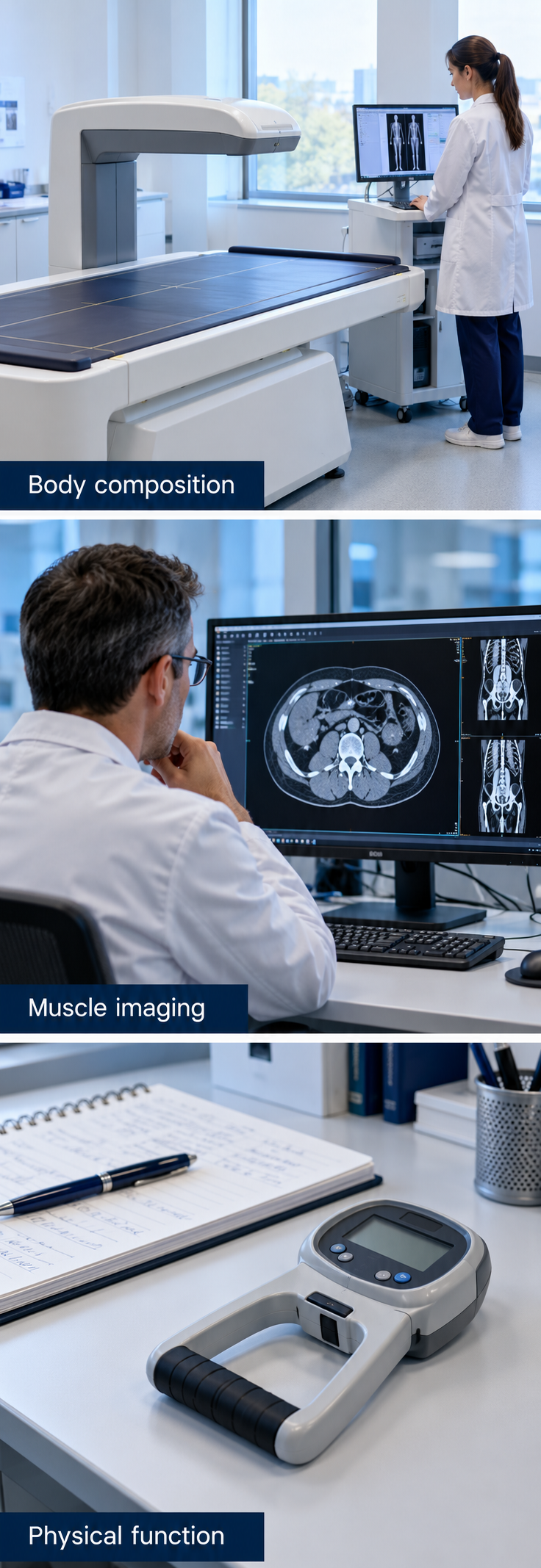
Researchers observed lower fat mass and higher lean mass without overall weight loss. DXA measurements showed average lean-mass changes of approximately:
- Tesamorelin: a 1.0 kg increase.
- Placebo: a 0.4 kg decrease.
The study also found reduced visceral fat compared with placebo.
This illustrates why body-composition findings can be valuable even when the scale changes little. The participants were selected for particular characteristics, so the results should remain connected to that population. Original body-composition trial.
Lean Mass Is Not the Same as Muscle Strength
Lean mass includes water and tissues other than skeletal muscle.
An increase can be a useful body-composition finding, but it does not independently demonstrate new muscle protein, improved strength, or better athletic performance.
Direct Muscle Imaging Added Another Clue
An exploratory analysis of earlier HIV trials examined CT-measured trunk muscle.
The comparison included placebo recipients and tesamorelin responders, defined by at least an 8% reduction in visceral fat. Researchers reported increased muscle density, consistent with less fat within muscle, and increases in lean muscle area.
These findings provide a reason to investigate muscle composition further. However, selecting responders limits generalization, and the analysis did not establish improved strength or physical function. Original muscle-imaging analysis.
What Do the Findings Mean for Tesamorelin Peptide Benefits?
The clearest tesamorelin peptide benefits reported in these studies concern changes in specific fat compartments and body composition.
| Research finding | Why it matters | Evidence boundary |
|---|---|---|
| Reduced visceral fat | Demonstrates a change in internal abdominal fat measured by imaging | Strongest established clinical application is in HIV-associated excess abdominal fat |
| Reduced liver fat | Extends the findings to fat stored within liver tissue | Trials discussed here involved people with HIV |
| Increased lean mass alongside lower fat mass | Shows why body composition can change without substantial weight loss | Lean mass is not a direct strength measurement |
| Improved muscle-imaging measures | Suggests changes in muscle fat content and area | Exploratory responder analysis; functional benefits remain uncertain |
Sources: visceral-fat trial, liver-fat trial, body-composition trial, and muscle analysis.
These are more informative than a broad claim that tesamorelin “burns belly fat.” Each identifies a tissue, a measurement, and a studied population.
How Far Do These Findings Extend?
Clinical Populations Matter
The pivotal evidence involved adults with HIV and abdominal fat accumulation. Other research has examined selected groups, including adults with abdominal obesity and reduced growth hormone secretion.
These findings provide a basis for further investigation. They do not establish the same response in every healthy person seeking fat loss.
Fat Reduction and Weight Loss Are Different Outcomes
A percentage change in visceral fat cannot be directly compared with a percentage change in total body weight.
This also matters when comparing tesamorelin with GLP-1-based approaches. Tesamorelin acts through GHRH signaling, while GLP-1-based research involves different receptor pathways.
Retatrutide, for example, activates GIP, GLP-1, and glucagon receptors. Its mechanism differs from tesamorelin’s. Comparisons require matching populations, durations, and outcomes—not ranking unrelated percentages. Retatrutide clinical research.
The differences do not establish that combining these approaches produces better results.
Approved Use and Safety Context
The FDA-approved medicine EGRIFTA WR, containing tesamorelin, is indicated to reduce excess abdominal fat in adults with HIV-associated lipodystrophy. It is not indicated for general weight-loss management.
Important warnings include elevated IGF-1, glucose intolerance or diabetes, fluid retention, hypersensitivity, and malignancy-related considerations. Contraindications include active malignancy, pregnancy, and certain disruptions of the hypothalamic-pituitary system.
Common adverse reactions include joint or muscle pain, peripheral edema, and injection-site reactions. Long-term cardiovascular safety has not been established. Official prescribing information.
These conclusions concern the medicine and studied formulations. They do not establish the quality, safety, or suitability for human use of a supplier’s research material.

Frequently Asked Questions
What Is Tesamorelin Most Clearly Supported For?
Its most established clinical application is reducing excess abdominal fat in adults with HIV-associated lipodystrophy.
Additional studies support investigation of liver fat and body composition in defined populations.
Does Tesamorelin Reduce All Types of Belly Fat?
No. Evidence of reduced visceral fat does not establish an equal reduction in subcutaneous fat or guarantee a particular abdominal appearance.
Does Tesamorelin Cause Overall Weight Loss?
Its prescribing information describes a weight-neutral effect and states that it is not indicated for weight-loss management.
Fat distribution can change without substantial overall weight loss. Approved-use information.
Does Tesamorelin Build Muscle?
Studies have reported lean-mass increases and exploratory changes in muscle imaging.
Those findings do not establish improved strength, exercise recovery, or a predictable bodybuilding effect.
Are Tesamorelin and Retatrutide the Same Type of Peptide?
No. Tesamorelin is a GHRH analogue. Retatrutide activates GIP, GLP-1, and glucagon receptors.
They have different mechanisms and clinical research backgrounds.
Can the Trial Results Be Applied to Research-Use Tesamorelin?
The findings relate to the preparations and conditions studied.
A research material does not automatically inherit the finished medicine’s approval status, quality controls, or clinical conclusions.

What the Trial Changed About the Conversation

The 26-week trial gave researchers a concrete finding to build on: visceral fat could decrease measurably in the studied population.
Later work added evidence involving liver fat, lean mass, and muscle composition. Together, these studies show why tesamorelin research is best understood through specific tissues and measurements.
Its research value lies in those distinctions—where fat changes, how the change is measured, and whether it translates into meaningful longer-term outcomes.
Explore Novacybio’s tesamorelin research material specifications, or contact us for available product and batch documentation.
References
- Falutz J, et al. Metabolic effects of a growth hormone-releasing factor in patients with HIV. The New England Journal of Medicine. 2007;357(23):2359–2370. doi:10.1056/NEJMoa072375.
- Stanley TL, et al. Effect of tesamorelin on visceral fat and liver fat in HIV-infected patients with abdominal fat accumulation: a randomized clinical trial. JAMA. 2014;312(4):380–389. doi:10.1001/jama.2014.8334.
- Stanley TL, et al. Effects of a Growth Hormone-Releasing Hormone Analog on Endogenous GH Pulsatility and Insulin Sensitivity in Healthy Men. The Journal of Clinical Endocrinology & Metabolism. 2011;96(1):150–156. doi:10.1210/jc.2010-1587.
- Stanley TL, et al. Effects of Tesamorelin on Nonalcoholic Fatty Liver Disease in HIV: A Randomized, Double-Blind, Multicenter Trial. The Lancet HIV. 2019;6(12):e821–e830. doi:10.1016/S2352-3018(19)30338-8.
- Makimura H, et al. Metabolic Effects of a Growth Hormone-Releasing Factor in Obese Subjects with Reduced Growth Hormone Secretion: A Randomized Controlled Trial. The Journal of Clinical Endocrinology & Metabolism. 2012;97(12):4769–4779. doi:10.1210/jc.2012-2794.
- Adrian S, et al. The Growth Hormone Releasing Hormone Analogue, Tesamorelin, Decreases Muscle Fat and Increases Muscle Area in Adults with HIV. The Journal of Frailty & Aging. 2019;8(3):154–159. doi:10.14283/jfa.2018.45.
- Jastreboff AM, et al. Triple-Hormone-Receptor Agonist Retatrutide for Obesity — A Phase 2 Trial. The New England Journal of Medicine. 2023;389(6):514–526. doi:10.1056/NEJMoa2301972.
- U.S. Food and Drug Administration. EGRIFTA WR (tesamorelin) prescribing information. Revised March 2025.