
Blog
How to Read a Peptide COA: Purity, Identity, Content, and Batch Traceability


When comparing research peptides, a certificate of analysis can help you evaluate the material behind a product listing.
But a headline purity percentage is only one part of the document. It does not tell you everything about molecular identity, peptide quantity, or whether the tested sample matches the batch you will receive.
A useful peptide COA connects a clearly identified material and batch to specific tests, methods, and results.
This guide explains how to read those details and which questions to ask before a laboratory purchase.
Key takeaways
- Identity, purity, and content answer different questions.
- HPLC can support purity testing or quantitative analysis, depending on the method.
- A matching molecular mass supports identity but does not resolve every structural question.
- Documentation should connect the tested sample to the supplied batch.
- A COA cannot establish human safety, clinical effectiveness, or regulatory approval.
What Can a Peptide COA Tell You?

COA stands for Certificate of Analysis. It reports analytical findings for an identified material, usually in relation to a particular batch and specification.
Start with four questions:
- What material was tested?
- Which batch or sample was tested?
- What tests were performed?
- What did the results establish?
ICH Q7 describes batch identification, acceptance limits, results, dates, and authorized approval among the elements of an API certificate. These provide a useful document-reading framework. 1
Scope matters: ICH Q7 addresses pharmaceutical active ingredients. The EMA peptide guidance cited below also concerns medicinal-product development. They inform this guide’s analytical explanations; they do not certify a research supplier or create identical requirements for every research reagent.
Identity, Purity, and Content: Three Different Questions
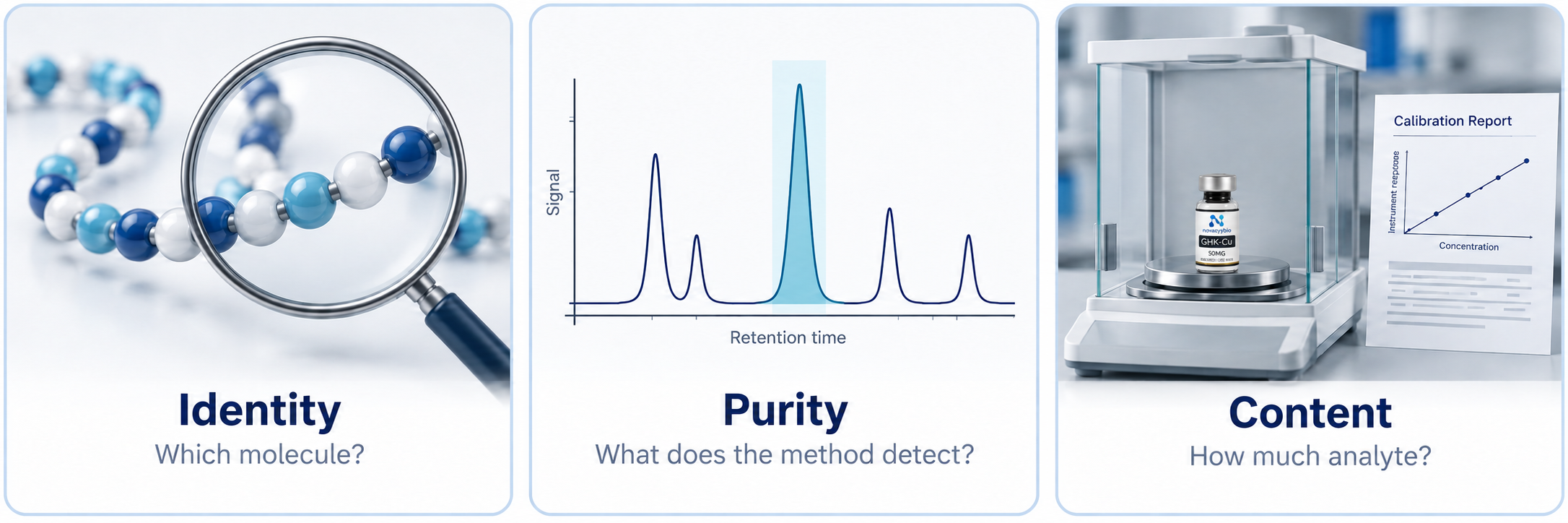
| Term | Question it answers | What to examine |
|---|---|---|
| Identity | Is this consistent with the intended molecule? | Sequence, modifications, chemical form, and identification methods |
| Purity | What components are detected and distinguished by the method? | Separation, detection conditions, and calculation |
| Content or assay | How much of the specified analyte is present? | Units, calibration, reference material, and reporting basis |
Identity
A name alone is not an analytical identification.
Confirm relevant structural details: sequence, terminal modifications, conjugated groups, or copper complexation, for example.
The identification approach should be appropriate to the molecule. EMA’s synthetic-peptide guidance discusses complementary analytical methods because a single measurement may not resolve every identity question. 2
Purity
A purity result is meaningful within the scope of its method.
For example, an HPLC peak-area percentage describes the relative detector response assigned to the target peak under specified conditions. It should not automatically be read as a mass percentage of everything in the vial.
Content or Assay
Content testing addresses quantity. Ask whether the result is reported as a concentration, mass fraction, or amount per container.
Also check its basis: material as received, dried material, or a defined counterion-free basis.
Water and counterions can affect the relationship between powder weight and peptide quantity. A presentation on peptide quality controls distinguishes purity testing from assay and mass-balance considerations. 3
A bulk-material assay also does not, by itself, verify the fill amount of every packaged vial.
How to Read HPLC and Mass Spectrometry Results
HPLC: Look Beyond the Largest Peak
High-performance liquid chromatography separates sample components under defined conditions. The output is a chromatogram.
For a purity report, request enough information to understand:
- Which peak was assigned to the target.
- The detection conditions.
- The integration and calculation approach.
- Whether nearby components were adequately separated.
- Whether the report identifies the tested sample.
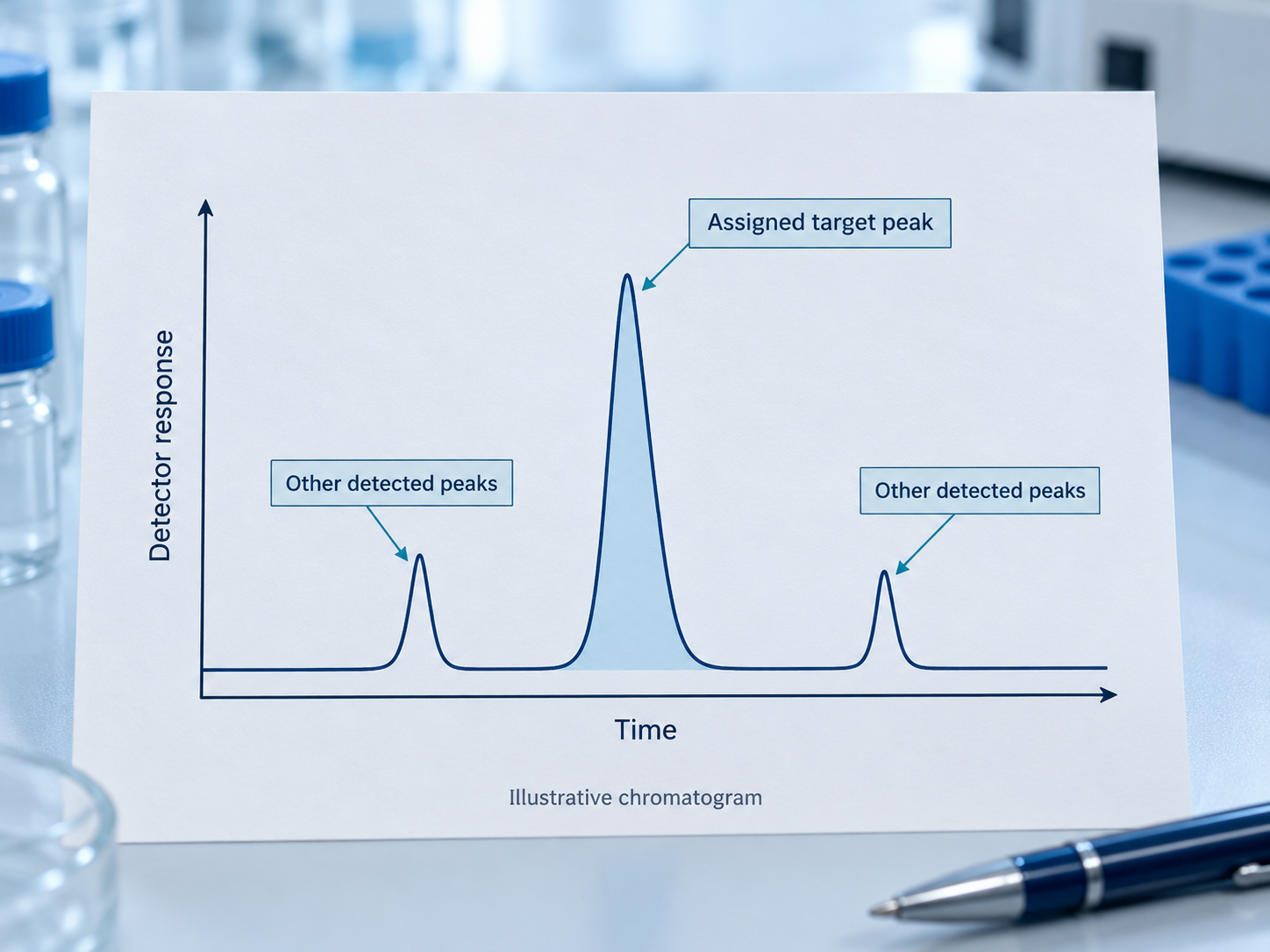
A large peak can contain overlapping components. Different compounds can also produce different detector responses.
HPLC can perform quantitative assay work when configured and calibrated for that purpose. “Tested by HPLC” alone does not identify what was measured.
Published peptide-assay recommendations discuss the complementary roles of chromatography, mass spectrometry, and peptide quantification. 4
Mass Spectrometry: Check the Interpretation
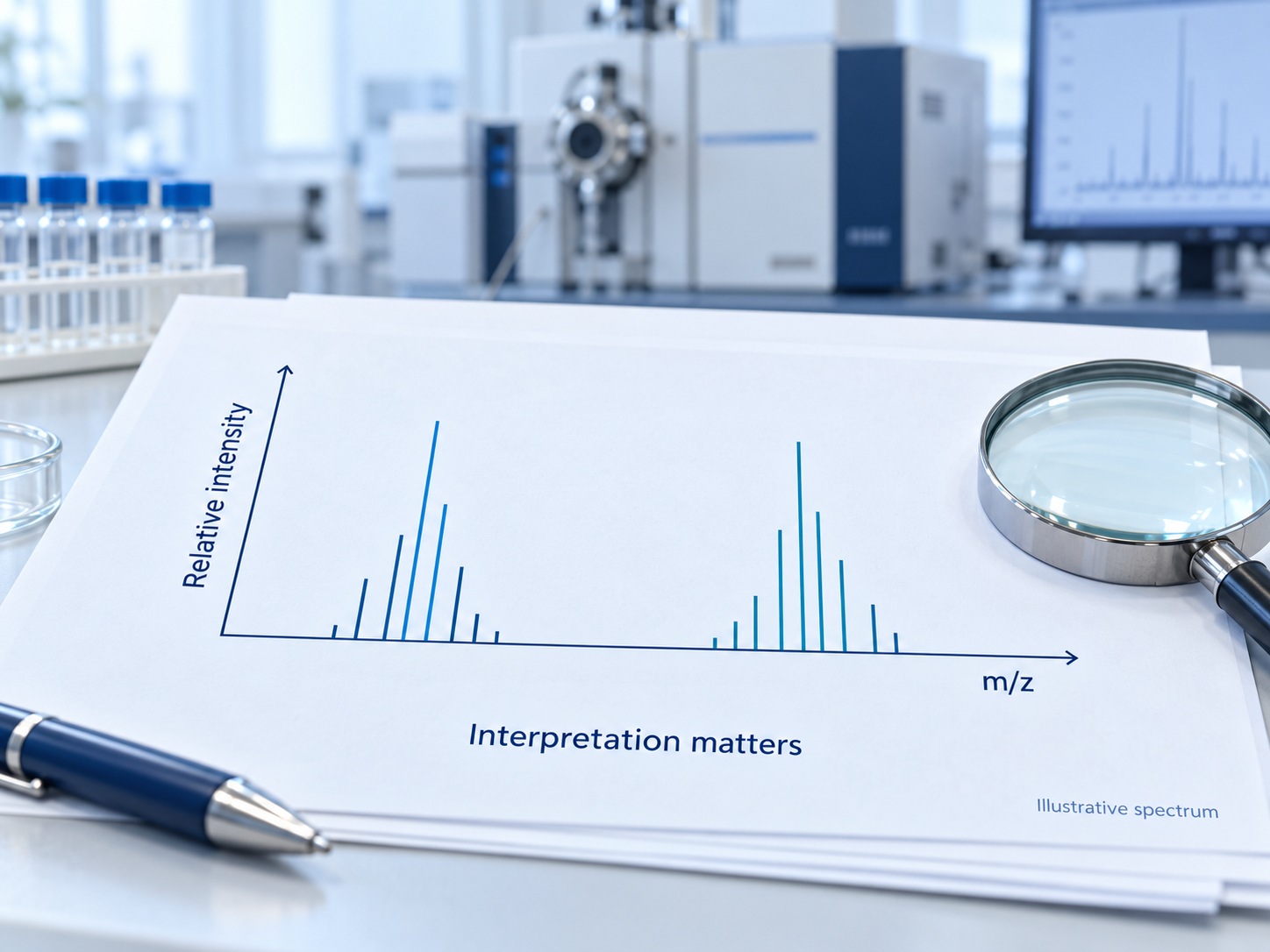
Mass spectrometry, or MS, measures mass-to-charge ratios. Reports may show charged ions, an interpreted molecular mass, or both.
Ask the laboratory to explain how the observed result was compared with the expected molecule.
A consistent intact mass supports identity. It does not independently establish the complete sequence, every modification position, or stereochemical purity. Additional structural methods may be needed. 2, 3
Check Whether the Method Fits the Question
A method that detects a target may not accurately quantify it or separate important impurities.
ICH Q2(R2) discusses analytical performance characteristics such as specificity, accuracy, precision, and quantitation limits. Research buyers can ask what evidence supports a method’s suitability without assuming every assay requires the same validation package. 5
How to Verify Batch Traceability
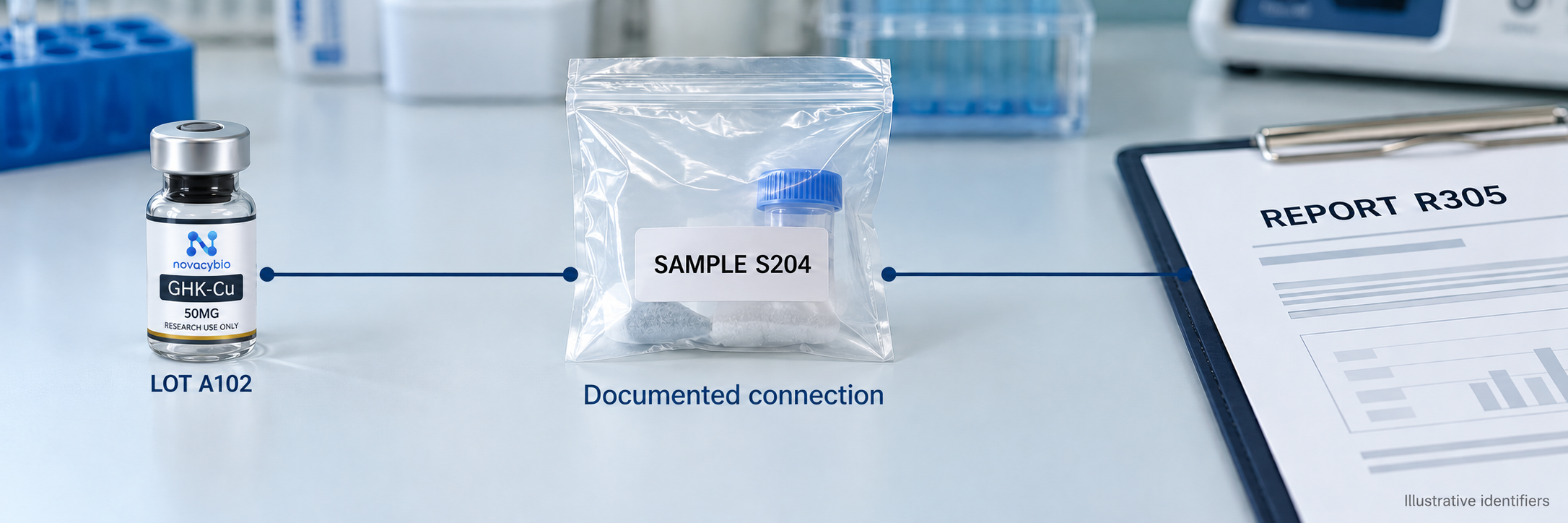
Traceability connects the material ordered, the sample tested, and the material received.
Match the Identifiers
Compare the product name, supplier lot number, laboratory sample ID, and report number.
These identifiers may differ legitimately. Ask for the documented connection between them.
Review Dates and Document Versions
Distinguish sampling, testing, report issuance, and batch-release dates.
Where provided, review the retest or expiry date alongside storage conditions. A retest date is not the same as an expiry date; ask what each means for the supplied material.
A recent report date alone does not establish recent manufacture.
Identify Who Issued the Document
A supplier COA and an external laboratory report may be separate documents.
Check who performed the tests, who issued the COA, and whether the report can be authenticated. If verification matters, obtain laboratory contact details independently.
Independent testing still needs a sample connection: ask who selected and submitted the sample and how it relates to the stock being shipped.
Check Repacking and Filling
If bulk material was divided into smaller containers, ask how the packaged lot maps to the original tested batch.
Determine which results concern the bulk material and which, if any, concern the packaged product.
What Additional Information Do Peptide Blends Need?
A blend name is not a complete specification.
For multi-component research materials, request:
- Identity of every intended component.
- Quantity or concentration of each component.
- The stated ratio and its basis.
- Methods that distinguish relevant components.
- Documentation connecting the tested blend to the supplied lot.
One overall chromatographic percentage does not establish that the blend contains the correct proportions.
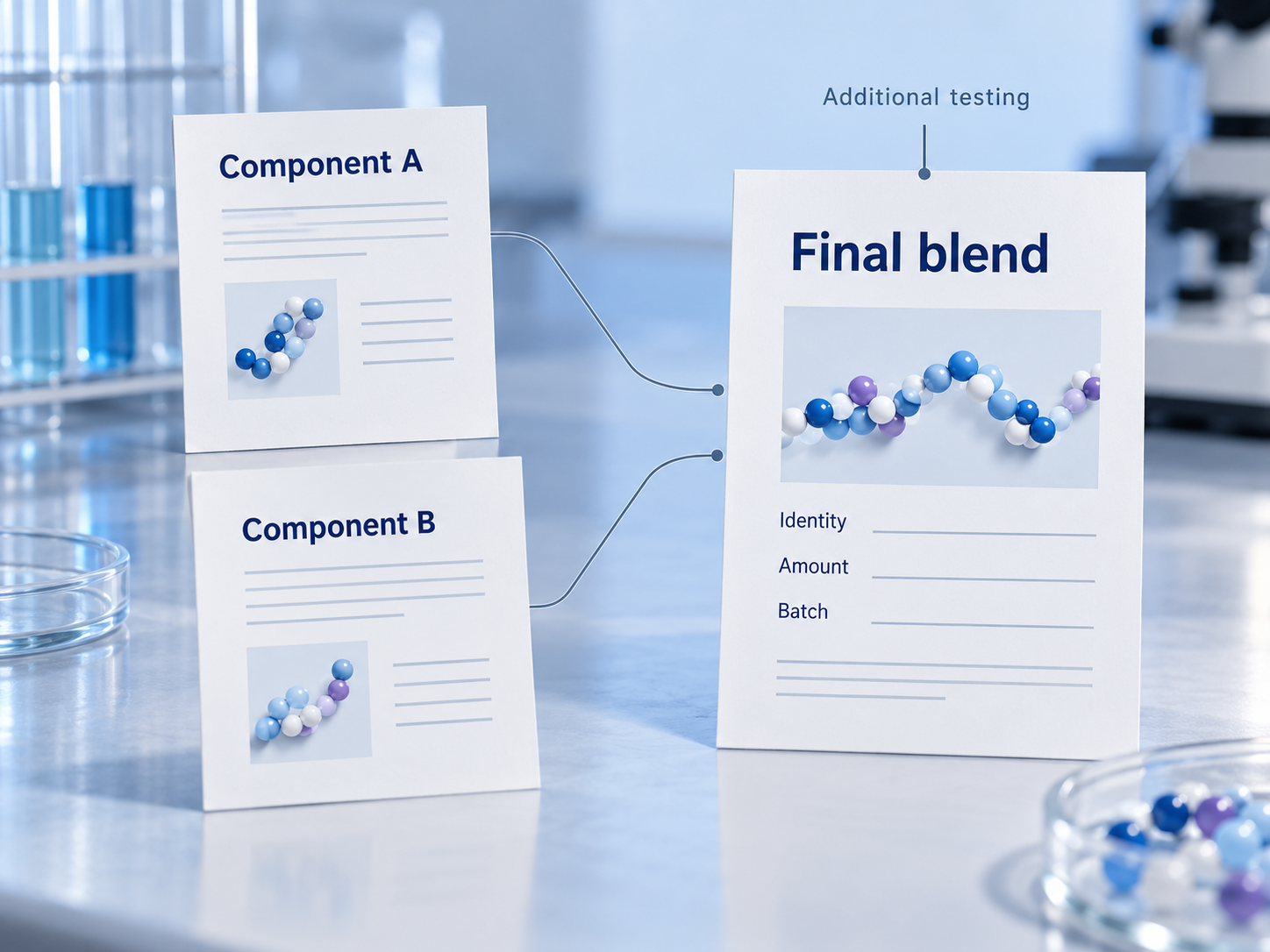
Likewise, COAs for separate starting ingredients do not establish the final blend’s composition or consistency after mixing and filling.
Which Experiments May Need Additional Quality Information?
Select requirements according to the molecule and protocol.
| Research context | Information worth discussing |
|---|---|
| Quantitative assays or reference-standard work | Assigned content, calibration, uncertainty, and stability |
| Sensitive cell experiments | Relevant endotoxin or microbial data and possible interfering residues |
| Aggregation-sensitive studies | Appropriate aggregate or oligomer measurements |
| Stereochemistry-dependent work | Methods capable of assessing relevant stereochemical differences |
| Copper-peptide experiments | Identity and composition of the intended copper complex |
| Repeated or long-term studies | Batch comparability, storage history, and stability information |
There is no universal test panel for every experiment.
Define acceptance criteria with the research team before ordering. If a required test is absent, request it or assess whether qualified independent testing is needed.
“Not reported” means the result is unavailable in that document. It should not be interpreted as a passing result.

Where to Buy Peptides for Research: Questions to Ask First
When evaluating where to buy peptides for laboratory work, compare documentation alongside price and availability.
The phrase high purity research peptides becomes useful only when the underlying result is clear and relevant.
Ask the supplier:

- Can you provide the specification and COA for the batch available?
- What methods support identity, purity, and content?
- Are numerical results and acceptance criteria available?
- Can you share supporting chromatograms or spectra?
- How does the laboratory sample ID connect to the supplied lot?
- What does the labeled amount per vial represent?
- For blends, how is each component quantified?
- Which additional tests are available?
- What storage and stability information supports handling?
- How are discrepancies or nonconforming results handled?
For comparable supplier quotations, request the same specification, documentation scope, and packaging information.
When Should You Request Clarification?
Pause the procurement assessment when:
- The report cannot be connected to the offered lot.
- Product descriptions conflict across documents.
- “Pass” appears without an understandable criterion.
- A purity percentage is presented as proof of vial content.
- The testing laboratory or report identity cannot be verified.
These are reasons to investigate—not automatic proof that a product is defective.
Why a COA Cannot Establish Human Safety or FDA Approval
A COA reports analytical findings. Human safety and clinical effectiveness require different evidence.
A material can meet specified analytical criteria without being suitable for personal treatment.
Similarly, a laboratory report is not a drug-approval document. FDA explains that establishment registration or product listing does not itself constitute approval. 6
A report heading, laboratory logo, or purity claim should never be treated as authorization for human use.

Frequently Asked Questions
Is Higher HPLC Purity Always Better?
A larger reported value is not automatically a more useful material. Compare methods, impurity separation, and experimental requirements.
Can Mass Spectrometry Confirm Everything About a Peptide?
No. It can provide important identity evidence, but the conclusion depends on the experiment and interpretation. Additional methods may be needed.
Are Peptide Content and Vial Weight the Same?
Not necessarily. Confirm whether the stated weight represents total material, peptide quantity, or another defined basis.

Does a COA Guarantee Every Vial?
A report concerns the sample tested. Its relevance to other containers depends on sampling, processing, and batch traceability.
Is Third-Party Testing Enough?
Its value depends on laboratory competence, method suitability, report authenticity, and the connection between the sample and supplied material.
What If the Supplier Provides Only a Summary?
Ask for the details needed by the protocol. A summary may support initial screening while leaving questions unresolved.
Use the COA to Make a Defined Purchasing Decision
A useful peptide COA does more than display a purity number. It helps connect the material’s identity, analytical results, and batch history to the experiment.
Before purchasing, establish what information the study requires, identify any gaps, and request clarification.
For research-material and documentation inquiries, request the current specification, available batch COA, supporting reports, and confirmed packaging details.
References
- ICH. Q7: Good Manufacturing Practice Guide for Active Pharmaceutical Ingredients. Section 11.4: Certificates of Analysis.
- EMA. Guideline on the Development and Manufacture of Synthetic Peptides. EMA/CHMP/CVMP/QWP/367182/2025.
- Duncan K. CMC Regulatory Experiences and Expectations for Peptides. 2024 conference presentation. The presentation reflects the author’s views, not FDA policy.
- Hoofnagle AN, et al. Recommendations for the Generation, Quantification, Storage and Handling of Peptides Used for Mass Spectrometry-Based Assays. Clinical Chemistry. 2016;62(1):48–69.
- EMA/ICH. ICH Q2(R2): Validation of Analytical Procedures.
- FDA. Is It Really “FDA Approved”?.