
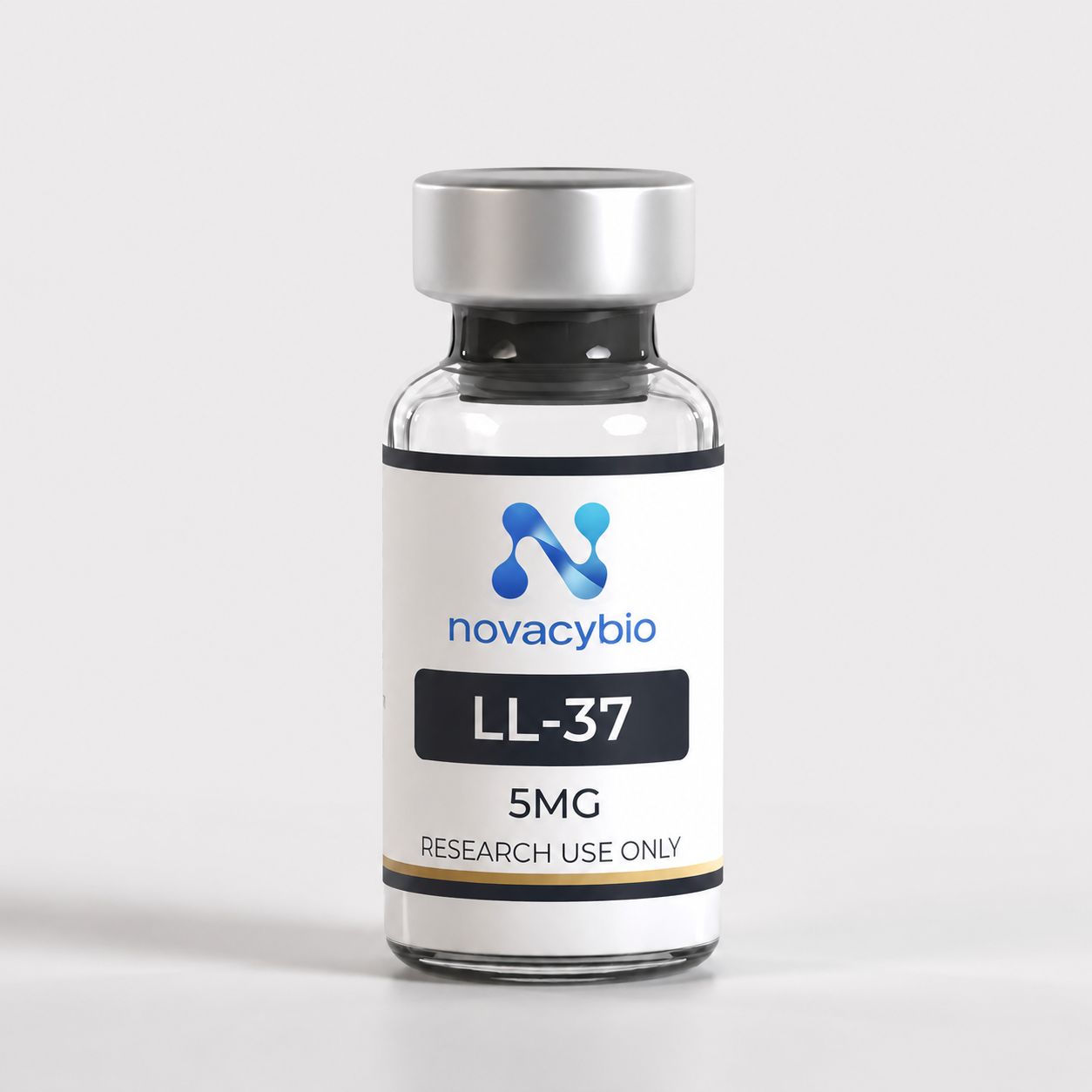
LL-37 Peptide – Research Grade Antimicrobial Peptide
Product Overview
LL-37 Peptide is a synthetic research peptide derived from the human cathelicidin antimicrobial peptide family. It represents the active 37-amino-acid C-terminal fragment of human cationic antimicrobial protein 18 (hCAP18/LL-37) and is widely studied as a model peptide in antimicrobial, innate immunity, and cellular signaling research.
LL-37 is supplied as a research-grade peptide compound for qualified laboratories, biotechnology companies, and academic research institutions investigating host defense mechanisms, immune signaling pathways, and peptide biology.
1. What is LL-37 Peptide? (Identity & Positioning)
Identity & Research Positioning
LL-37 Peptide is a naturally derived human antimicrobial peptide sequence used as a molecular research tool in immunology and cell biology studies.
LL-37 belongs to the cathelicidin family of host defense peptides and represents one of the best-characterized human antimicrobial peptides.
Product Identity
| Category | Information |
|---|---|
| Product Name | LL-37 Peptide |
| Peptide Family | Cathelicidin Antimicrobial Peptide |
| Peptide Length | 37 Amino Acids |
| Origin | Human Cathelicidin-Derived Peptide |
| Research Category | Antimicrobial Peptide (AMP) |
| Research Focus | Innate Immunity, Host Defense, Cell Signaling |
LL-37 is primarily researched for understanding peptide-mediated biological interactions, immune response mechanisms, and antimicrobial activity.
2. Peptide Category Positioning
Research Peptide Classification
LL-37 belongs to the following research peptide categories:
Primary Category
Antimicrobial Peptide (AMP)
Secondary Categories
-
Host Defense Peptide
-
Cathelicidin-Derived Peptide
-
Innate Immunity Research Peptide
-
Immunology Research Compound
-
Cell Signaling Research Peptide
-
Molecular Biology Research Tool
3. Research Logic & Development Background
Scientific Research Rationale
The development of LL-37 research peptides is based on studying the biological role of naturally occurring antimicrobial peptides within the human innate immune system.
Human cathelicidin precursor protein hCAP18 can be processed into the active LL-37 peptide fragment.
Research into LL-37 focuses on understanding:
-
Host-microbe interactions
-
Antimicrobial peptide mechanisms
-
Immune signaling pathways
-
Cellular response mechanisms
-
Peptide structure-function relationships
LL-37 contains a positively charged amphipathic alpha-helical structure, making it a valuable model peptide for studying peptide-membrane interactions and biological signaling.
4. Research Findings (Research Evidence)
Published Research Areas
Extensive laboratory research has investigated LL-37 in several areas:
Antimicrobial Mechanism Studies
Research has examined LL-37 as a model antimicrobial peptide for studying:
-
Microbial membrane interactions
-
Host defense mechanisms
-
Peptide structure-function relationships
Innate Immunity Research
Studies have investigated LL-37 involvement in:
-
Innate immune response mechanisms
-
Immune cell signaling
-
Host defense pathways
Cellular Biology Research
Research applications include investigation of:
-
Cell signaling pathways
-
Cellular migration mechanisms
-
Peptide-mediated biological interactions
Biotechnology Research
LL-37 continues to be studied as a reference molecule for:
-
Antimicrobial peptide discovery
-
Peptide engineering research
-
Biological mechanism studies
5. Research Applications
Laboratory Research Applications
LL-37 Peptide may be used in qualified laboratory research settings for:
| Research Area | Application |
|---|---|
| Antimicrobial Research | Investigation of antimicrobial peptide mechanisms |
| Immunology Research | Study of innate immune signaling pathways |
| Molecular Biology | Protein-peptide interaction studies |
| Cell Biology | Cellular response and signaling research |
| Biotechnology Development | Antimicrobial peptide platform research |
| Peptide Research | Structure-activity relationship studies |
6. Safety Profile
Research Safety Considerations
LL-37 Peptide is an experimental research compound supplied for laboratory investigation only.
Although LL-37 is derived from a naturally occurring human peptide sequence, research-grade peptide products are not approved pharmaceutical compounds.
Important considerations:
-
Biological activity depends on experimental conditions.
-
Safety profiles for human applications have not been established.
-
Long-term effects require further scientific evaluation.
-
Researchers should follow institutional laboratory protocols.
Appropriate handling procedures should be applied during storage and experimental use.
7. Final Product Positioning
Research Grade LL-37 Peptide
LL-37 Peptide is positioned as:
A high-quality antimicrobial research peptide for laboratories investigating host defense mechanisms, innate immunity pathways, and peptide-based biological research.
Target Customers
Suitable for:
-
Biotechnology companies
-
Pharmaceutical research organizations
-
Academic laboratories
-
Molecular biology research facilities
-
Life science research institutions
Product Advantages
✓ Synthetic research-grade peptide
✓ Antimicrobial peptide research application
✓ Supports immunology and molecular biology studies
✓ Batch-specific analytical documentation
✓ Professional laboratory supply format
8. Quality Documentation
Analytical Quality Documentation
Each LL-37 peptide batch can be supplied with comprehensive quality documentation.
Certificate of Analysis (COA)
The COA provides batch-specific verification including:
-
Product identification
-
Batch number
-
Purity information
-
Quality testing results
-
Manufacturing details
HPLC Report
High Performance Liquid Chromatography (HPLC) testing is used for peptide purity evaluation.
Documentation may include:
-
Chromatographic profile
-
Purity percentage
-
Retention time analysis
Mass Spectrometry
Mass spectrometry analysis confirms peptide identity through:
-
Molecular weight verification
-
Sequence confirmation
-
Analytical characterization
Batch Documentation
Supporting batch records may include:
-
Production information
-
Quality control records
-
Testing documentation
-
Traceability information
9. Storage Information
Recommended Storage Conditions
For maintaining peptide quality:
-
Store in a sealed container
-
Protect from moisture and contamination
-
Keep under recommended laboratory storage conditions
-
Avoid repeated freeze-thaw cycles
-
Follow supplier handling instructions
Storage requirements may vary depending on formulation and packaging conditions.
10. Research Disclaimer
Research Use Only Statement
LL-37 Peptide is supplied strictly for laboratory research purposes.
For research use only.
Not intended for human consumption.
Not intended for clinical or diagnostic use.
This product is not a pharmaceutical product, dietary supplement, medical treatment, or therapeutic agent.
Customers are responsible for ensuring compliance with applicable research regulations and institutional requirements.
11. FAQ – B2B SEO Questions
1. What is LL-37 peptide used for in research?
LL-37 peptide is primarily used as a research tool for studying antimicrobial peptide mechanisms, innate immunity pathways, and cellular signaling processes.
2. Is LL-37 considered an antimicrobial peptide?
Yes. LL-37 is a human cathelicidin-derived antimicrobial peptide widely studied in host defense and immune biology research.
3. What research applications are suitable for LL-37 peptide?
LL-37 peptide is commonly researched in antimicrobial studies, immunology research, molecular biology, and peptide structure-function investigations.
4. What quality documentation is available for LL-37 peptide?
Research suppliers typically provide COA, HPLC reports, mass spectrometry analysis, and batch documentation for quality verification.
5. How is LL-37 peptide purity verified?
LL-37 peptide purity is commonly evaluated through analytical methods such as HPLC, while molecular identity can be confirmed using mass spectrometry.
6. Who purchases LL-37 research peptide?
Typical customers include biotechnology companies, academic institutions, pharmaceutical research laboratories, and life science organizations.
7. How should LL-37 peptide be stored?
LL-37 peptide should be stored according to supplier recommendations, protected from moisture, temperature fluctuations, and repeated freeze-thaw cycles.
8. Is LL-37 peptide approved for human use?
No. LL-37 peptide is supplied strictly as a laboratory research compound and is not intended for human consumption, clinical use, or diagnostic applications.
评价
目前还没有评价