
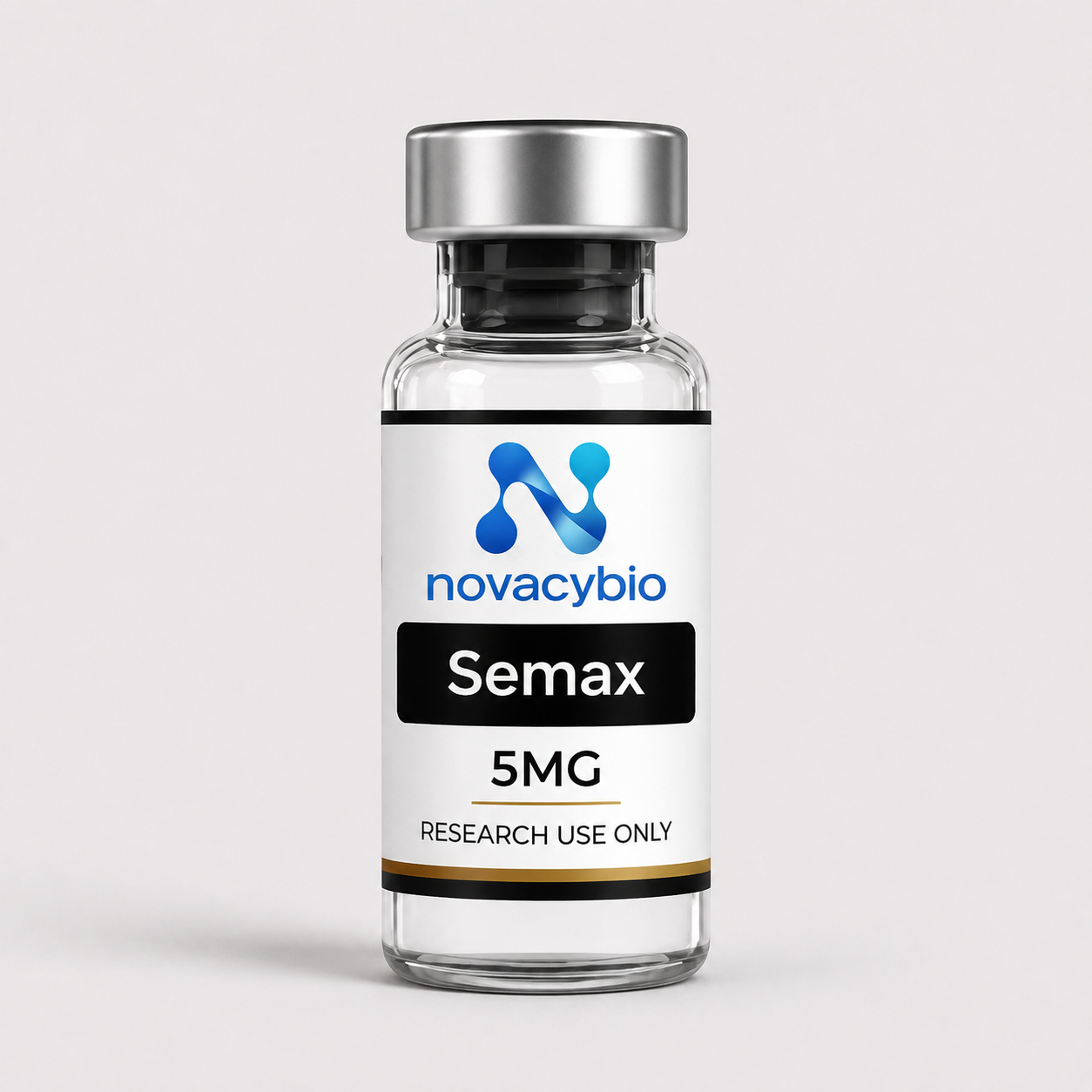
Semax Peptide
原价为:$59.99。$49.99当前价格为:$49.99。
ACTH-Derived Neuroactive Heptapeptide for Neuroscience Research with COA & HPLC Documentation
Semax Peptide
Synthetic ACTH-Derived Neuroactive Heptapeptide for Neuroscience Research
Semax is a synthetic neuroactive heptapeptide originally developed from the ACTH(4–10) fragment. It has been widely investigated in neuroscience research due to its potential involvement in neurotrophic signaling, cognitive-related pathways, and neuronal protection mechanisms.
As a research peptide, Semax is primarily studied in areas including neurobiology, molecular neuroscience, cognitive function research, and neuroprotective pathway investigation.
1. What is Semax?
Identity & Classification
Semax is a synthetic peptide consisting of seven amino acids:
Sequence:
Met-Glu-His-Phe-Pro-Gly-Pro (MEHFPGP)
Peptide Classification:
- Synthetic neuroactive peptide
- ACTH-derived peptide analogue
- Heptapeptide research compound
- Neuroscience research peptide
- Neuroregulatory peptide
Unlike endocrine peptides designed to regulate growth hormone or metabolic pathways, Semax belongs to the category of central nervous system (CNS)-focused research peptides.
Its primary research interest involves:
- Neural signaling pathways
- Neuroplasticity mechanisms
- Neurotrophic factor regulation
- Cognitive-related molecular pathways
2. Peptide Category Positioning
Where Does Semax Fit in Research Peptide Classification?
Research peptides can generally be divided into several functional categories:
| Category | Examples | Research Focus |
|---|---|---|
| Growth Hormone Related Peptides | CJC-1295, Ipamorelin | GH/IGF-1 pathways |
| Tissue Repair Peptides | BPC-157, TB-500 | Regeneration mechanisms |
| Metabolic Peptides | MOTS-c, AOD-9604 | Cellular metabolism |
| Anti-aging Research Peptides | Epitalon | Longevity pathways |
| Neuroactive Peptides | Semax | CNS signaling & neurobiology |
Semax belongs specifically to the neuroactive peptide category, making it relevant for laboratories conducting neuroscience and molecular biology research.
3. Research Background & Development Logic
From ACTH Fragment to Neuroactive Peptide
Semax was developed based on research into biologically active fragments of adrenocorticotropic hormone (ACTH).
The development concept:
ACTH-derived peptide fragment
↓
Identification of neuroactive properties
↓
Structural modification
↓
Creation of synthetic peptide analogue
↓
Investigation of CNS-related mechanisms
The objective of this research approach was to explore peptide sequences capable of influencing neural signaling pathways without maintaining classical hormonal activity.
4. Mechanism of Action (Research Overview)
Semax research has focused on several molecular pathways:
4.1 BDNF Regulation Research
One of the primary research areas surrounding Semax is its relationship with:
Brain-Derived Neurotrophic Factor (BDNF)
BDNF is involved in:
- Neuronal survival signaling
- Synaptic plasticity
- Learning and memory-related pathways
Research models have investigated whether Semax may influence BDNF-related gene expression and neurotrophic signaling pathways.
4.2 Neurotransmitter System Research
Semax has been investigated in relation to multiple neurotransmitter systems, including:
Dopaminergic pathways
Research interest:
- Neural motivation pathways
- Cognitive processing mechanisms
- Reward-related signaling
Serotonergic pathways
Research interest:
- Stress-response mechanisms
- Mood-related signaling pathways
4.3 Neuroprotective Pathway Research
Research studies have explored Semax in models related to:
- Oxidative stress mechanisms
- Neuroinflammatory pathways
- Neural recovery processes
The peptide continues to be investigated as a molecular tool for studying neuroprotective mechanisms.
5. Research Findings
Cognitive Function Research
Semax has been investigated in neuroscience models related to:
- Learning processes
- Memory formation
- Attention-related mechanisms
- Cognitive performance pathways
Research findings suggest potential involvement in neural plasticity-related processes.
Neuroprotection & Ischemic Research
Studies have investigated Semax in experimental models involving:
- Cerebral ischemia
- Neuronal stress response
- Recovery-associated pathways
Research areas include:
- Neuronal survival mechanisms
- Functional recovery pathways
- Cellular protection responses
Cognitive Disorder Research
Semax has been studied in research related to:
- Age-associated cognitive changes
- Attention-related pathways
- Cognitive impairment models
These studies focus on understanding molecular mechanisms involved in CNS function.
Stress Response Research
Additional research areas include:
- Stress adaptation pathways
- Neurochemical regulation
- Neural resilience mechanisms
6. Research Applications
Semax is supplied for laboratory research applications including:
Neuroscience Research
- Neural signaling pathway studies
- Neuroplasticity research
- CNS molecular biology research
Cognitive Research
- Memory pathway studies
- Learning mechanism research
- Cognitive neuroscience models
Neuroprotective Research
- Oxidative stress studies
- Neuroinflammation research
- Neural recovery models
Molecular Biology Research
- Gene expression studies
- Protein signaling analysis
- Cellular pathway investigations
7. Final Product Positioning
Semax Research Peptide Summary
Semax is positioned as:
A synthetic ACTH-derived neuroactive heptapeptide designed for neuroscience and molecular research applications.
Key research attributes:
- ACTH-derived peptide structure
- Seven amino acid sequence
- CNS-focused research interest
- Neurotrophic pathway investigation
- Neuroplasticity research relevance
Target research users:
- Neuroscience laboratories
- Academic institutions
- Biotechnology companies
- Pharmaceutical R&D organizations
- Molecular biology researchers
8. Quality Documentation
Research Grade Quality & Documentation
Each Semax peptide batch should be supported by comprehensive analytical documentation.
Available quality documentation includes:
Certificate of Analysis (COA)
The COA provides batch-specific quality information, including:
- Product identification
- Batch number
- Testing date
- Purity specification
- Analytical results
- Quality verification
HPLC Report
High Performance Liquid Chromatography (HPLC) analysis is used to evaluate:
- Peptide purity
- Chromatographic profile
- Batch consistency
Mass Spectrometry
Mass spectrometry analysis confirms:
- Molecular weight
- Peptide identity
- Expected molecular mass
Batch Documentation
Supporting documentation may include:
- Manufacturing records
- Batch traceability
- Quality control information
- Storage requirements
9. Storage Information
For optimal stability, Semax peptide should be stored according to supplier specifications.
Recommended storage conditions:
- Store in a cool, dry environment
- Protect from direct light exposure
- Maintain appropriate temperature conditions
- Keep sealed when not in use
Storage requirements may vary depending on formulation and packaging format.
Always follow the product-specific storage instructions provided with each batch.
10. Research Disclaimer
Research Use Only
Semax peptide is supplied strictly for laboratory research purposes.
For research use only.
Not intended for human consumption.
Not intended for clinical or diagnostic use.
This product is intended exclusively for qualified researchers, laboratories, and scientific institutions conducting controlled research.
11. FAQ
1. What is Semax peptide?
Semax is a synthetic ACTH-derived neuroactive heptapeptide studied primarily in neuroscience research, including neuroplasticity and neuroprotective pathway investigations.
2. What type of peptide is Semax?
Semax is classified as a synthetic neuroactive peptide and ACTH-derived heptapeptide used in CNS-related research applications.
3. What is the amino acid sequence of Semax?
The Semax peptide sequence is:
Met-Glu-His-Phe-Pro-Gly-Pro (MEHFPGP).
4. What research areas is Semax used for?
Semax is commonly investigated in:
- Neuroscience research
- Neuroplasticity studies
- Cognitive pathway research
- Neuroprotective mechanism studies
5. Does Semax belong to growth hormone peptides?
No. Semax is not a growth hormone secretagogue. It belongs to the neuroactive peptide category.
6. What analytical testing is available for Semax peptide?
Research-grade Semax batches may include:
- HPLC purity analysis
- Mass spectrometry confirmation
- Certificate of Analysis (COA)
- Batch documentation
7. How should Semax peptide be stored?
Storage conditions should follow supplier-specific recommendations. Proper storage helps maintain peptide stability and analytical integrity.
8. Is Semax intended for human use?
No.
Semax supplied by research peptide suppliers is intended strictly for laboratory research applications.
For research use only. Not intended for human consumption. Not intended for clinical or diagnostic use.
评价
目前还没有评价