
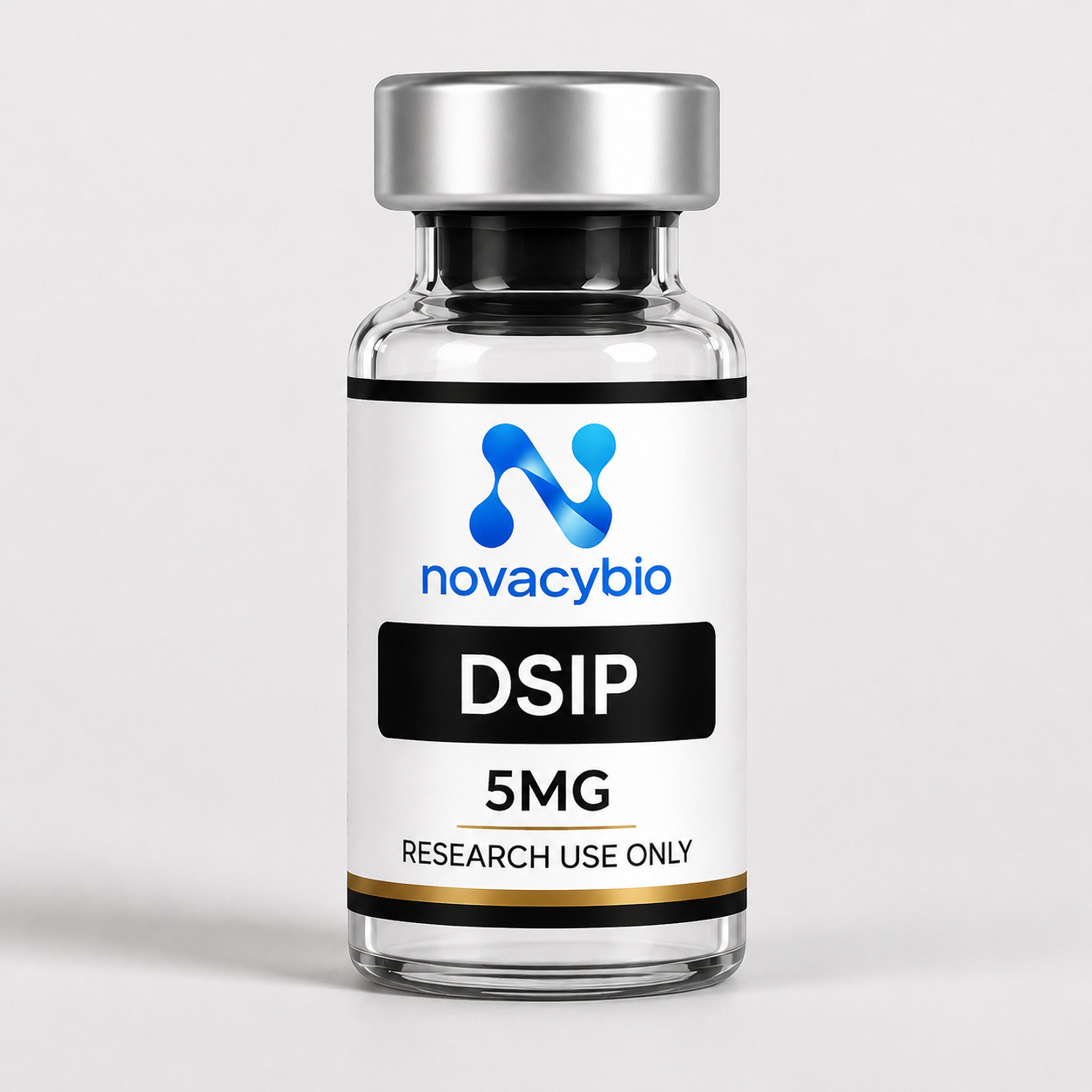

DSIP
原价为:$59.99。$49.99当前价格为:$49.99。
Delta Sleep-Inducing Peptide | Synthetic Neuropeptide Research Material
DSIP Research Peptide
Delta Sleep-Inducing Peptide Synthetic Research Material
1. Product Overview
DSIP (Delta Sleep-Inducing Peptide) Research Peptide is a synthetic neuropeptide research material designed for laboratory investigation of peptide-mediated signaling pathways, molecular communication systems, and biochemical regulatory mechanisms.
DSIP is a naturally identified endogenous nonapeptide consisting of nine amino acids. As a short-chain neuropeptide, DSIP provides researchers with a defined molecular structure for studying peptide interactions, biological signaling processes, and cellular communication mechanisms.
As a professional Synthetic Peptide Research Material, DSIP is manufactured through controlled solid-phase peptide synthesis and supplied as a high-purity laboratory compound for research applications including:
- Molecular signaling research
- Neurochemical pathway investigation
- Peptide-receptor interaction studies
- Protein-peptide binding analysis
- Cellular signaling research
DSIP research focuses on understanding how a specific peptide sequence communicates with biological systems at the molecular level, including how peptide molecules interact with molecular targets, influence signaling pathways, and participate in biochemical regulatory networks.
The scientific value of DSIP lies in its ability to serve as a molecular research model for investigating peptide-based communication mechanisms.
2. Research Background
Delta Sleep-Inducing Peptide (DSIP) was originally identified during research investigating naturally occurring peptide molecules involved in biological signaling and central nervous system communication.
Since its discovery, DSIP has been studied as a model neuropeptide due to its unique amino acid sequence and reported biological activity in experimental research models.
Scientific investigations have focused on understanding:
- Neuropeptide communication mechanisms
- Molecular signaling transmission
- Peptide-mediated regulatory pathways
- Protein interaction networks
- Cellular biochemical responses
Compared with traditional small molecules, peptides provide researchers with a unique opportunity to study biological regulation through sequence-specific molecular interactions.
DSIP continues to be investigated as a research tool for understanding how short peptide molecules interact with complex biological systems.
3. Research Function & Biological Activity
Molecular Signaling Research
DSIP is primarily studied as a peptide signaling molecule involved in molecular communication research.
The basic research mechanism can be described as:
DSIP Peptide → Molecular Recognition → Target Interaction → Signaling Pathway Response
Researchers investigate how DSIP interacts with biological targets through peptide recognition mechanisms.
Key research areas include:
- Peptide molecular recognition
- Signal pathway activation analysis
- Receptor interaction studies
- Downstream cellular signaling investigation
The purpose of DSIP research is to identify how peptide structures influence biological communication pathways at the molecular level.
Peptide-Receptor Interaction Research
A major research focus of DSIP is understanding how peptide molecules interact with potential biological receptors or binding targets.
Researchers study:
- Peptide binding characteristics
- Molecular affinity
- Target recognition mechanisms
- Structure-activity relationships
Because the specific molecular receptor and complete signaling pathway of DSIP remain areas of ongoing investigation, DSIP provides a valuable model for receptor discovery and pathway analysis.
Biological Activity Investigation
DSIP biological activity is evaluated through controlled laboratory experiments designed to understand molecular behavior.
Research investigates:
- How DSIP interacts with biological molecules
- How peptide structure affects activity
- How molecular signals are transmitted
- How cellular systems respond to peptide stimulation
Experimental studies focus on molecular mechanisms rather than clinical applications.
Neurochemical Signaling Pathway Research
DSIP has been investigated in relation to several neurochemical signaling systems.
Research areas include:
- GABAergic signaling pathways
- Dopaminergic signaling pathways
- Serotonergic signaling pathways
- Stress-associated molecular signaling
Researchers analyze whether DSIP influences communication between signaling molecules and cellular pathways.
The research objective is to understand:
Peptide Signal → Molecular Pathway → Cellular Response
Protein-Peptide Interaction Research
DSIP serves as a molecular model for studying protein-peptide interactions.
Research applications include:
- Protein recognition studies
- Binding affinity analysis
- Molecular docking research
- Structural interaction evaluation
The defined DSIP peptide sequence allows researchers to analyze how amino acid arrangement influences molecular binding behavior.
Cellular & Biochemical Research
DSIP is investigated using laboratory models to evaluate:
- Cellular signaling changes
- Molecular pathway responses
- Biochemical interaction patterns
- Peptide stability characteristics
Common research approaches include:
- Cell-based assays
- Molecular binding studies
- Biochemical analysis
- Analytical peptide characterization
4. Technical Overview
Molecular Characteristics
DSIP is a synthetic nine-amino-acid neuropeptide designed for molecular and biochemical research applications.
Key molecular characteristics:
- Short-chain peptide structure
- Defined amino acid sequence
- Synthetic laboratory production
- High analytical characterization
Peptide Structure
Peptide Classification: Synthetic Neuropeptide
Peptide Length: 9 Amino Acids
Sequence:
Trp-Ala-Gly-Gly-Asp-Ala-Ser-Gly-Glu
The defined peptide sequence provides researchers with a consistent molecular model for structure-function studies.
Analytical Characteristics
DSIP Research Peptide can be characterized through:
- High Performance Liquid Chromatography (HPLC)
- Mass Spectrometry (MS)
- Peptide purity analysis
- Molecular identification testing
5. Product Specifications
| Specification | Details |
|---|---|
| Product Name | DSIP Research Peptide |
| Category | Synthetic Research Peptide |
| Type | Neuropeptide Research Material |
| Purity | ≥98% HPLC Tested |
| CAS Number | 62568-57-4 |
| Molecular Weight | Approximately 848.9 g/mol |
| Molecular Formula | C35H48N10O15 |
| Sequence | Trp-Ala-Gly-Gly-Asp-Ala-Ser-Gly-Glu |
| Appearance | White Lyophilized Powder |
| Form | Freeze-Dried Peptide |
| Analytical Method | HPLC / Mass Spectrometry |
| Documentation | COA, HPLC Report, MS Report |
| Packaging | Research Grade Vials |
| Storage | Controlled Temperature Storage |
6. Research Applications
Molecular Biology Research
DSIP supports molecular biology studies involving:
- Peptide signaling pathways
- Molecular communication mechanisms
- Signal transduction research
- Structure-function relationship studies
Cellular Research
Research applications include:
- Cellular signaling investigation
- Molecular pathway screening
- Peptide interaction studies
- Cellular response analysis
Biochemical Research
DSIP is used for:
- Protein-peptide interaction studies
- Molecular binding analysis
- Biochemical mechanism research
- Peptide stability evaluation
Analytical Chemistry Research
Applications include:
- Peptide identification
- Purity verification
- Structural confirmation
- Analytical method development
7. Quality Highlights
✓ High Purity Standard
DSIP Research Peptide is manufactured using controlled peptide synthesis procedures with strict quality requirements.
✓ HPLC Testing
Analytical HPLC testing is performed to verify peptide purity and batch consistency.
✓ COA Available
Certificate of Analysis documentation is available to support professional research procurement.
✓ Research Grade Material
Supplied exclusively as laboratory research material for scientific applications.
✓ Batch Verification
Each batch undergoes quality verification procedures to ensure consistency.
✓ Quality Control
Comprehensive quality control processes support reliable laboratory research use.
8. Quality Documentation
COA (Certificate of Analysis)
Documentation includes:
- Product identification
- Batch information
- Purity results
- Analytical specifications
HPLC Report
HPLC analysis provides:
- Purity profile
- Chromatographic verification
- Batch quality assessment
Mass Spectrometry
MS testing confirms:
- Molecular weight
- Peptide identity
- Structural characteristics
Batch Documentation
Available documentation supports:
- Laboratory quality management
- Scientific procurement requirements
- Research material verification
相关产品


评价
目前还没有评价