
Blog
Peptides for Weight Loss, Skin, and Recovery: Which Ones Have Evidence?


If you have searched for peptides, you have probably seen the same promises repeated: easier weight loss, healthier-looking skin, and faster recovery.
The confusing part is that these discussions mix prescription medicines, skincare ingredients, experimental compounds, and research products.
So which peptides are associated with which goals—and how much should you trust the claims?
This guide explains the main differences in plain English, then provides a checklist for readers purchasing materials for laboratory research.
Key takeaways
Some peptide medicines have established uses, but evidence does not transfer automatically to similarly named research products.
GHK-Cu, BPC-157, and popular peptide blends need to be evaluated according to the actual formulation and evidence.
A familiar product name or high purity percentage cannot establish a health benefit.
Research buyers should confirm the exact composition, specifications, and batch documents.
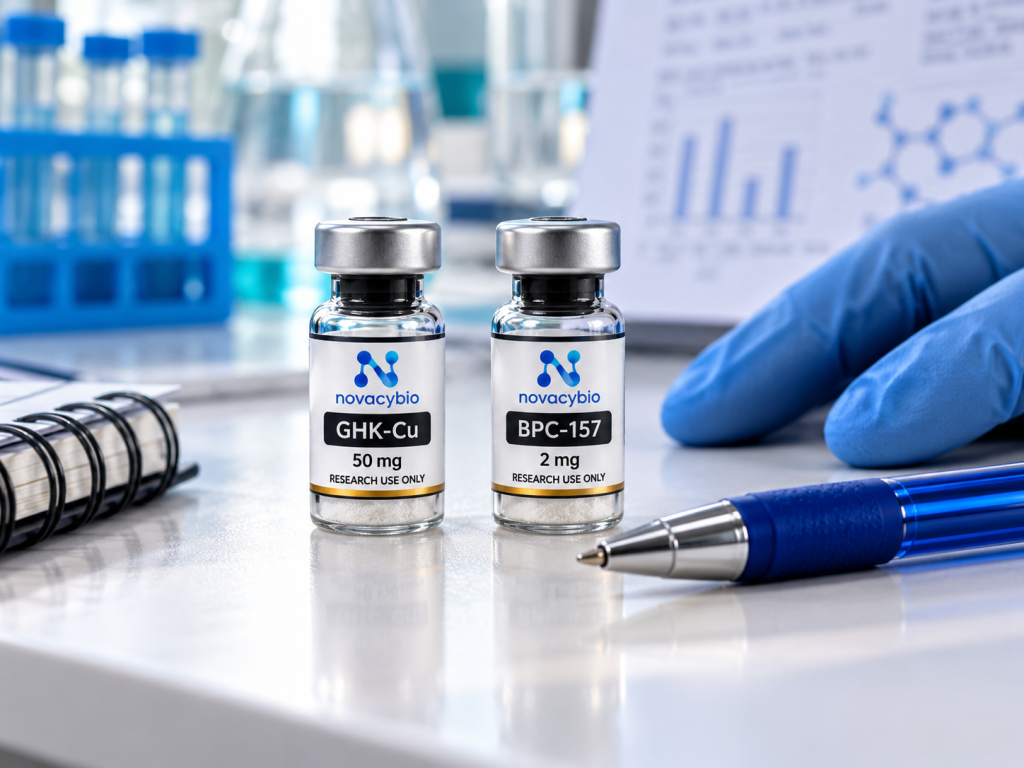
Quick Comparison: Which Peptides Are Discussed for Which Goals?
This table describes the evidence and questions worth investigating. It is not a guide to selecting a research product for personal use.

| Goal or topic | Names commonly encountered | What matters most |
|---|---|---|
| Weight management | Semaglutide, tirzepatide | Evidence for specific approved medicines and individual medical suitability |
| Emerging weight-management research | Retatrutide | The trial phase, population, formulation, and outcomes |
| Skin and cosmetic research | GHK-Cu | Whether evidence concerns cells, a finished topical product, or another formulation |
| Tissue-repair research | BPC-157, TB-500 | Exact molecular identity and the limits of human evidence |
| Multi-component research | Glow, Klow, Wolverine stacks | The actual ingredients and evidence for the combination |
| Growth-hormone signaling | CJC-1295, ipamorelin | Whether a study measured hormones or meaningful health outcomes |
What Are the Best Peptides for Weight Loss?
For someone seeking treatment, the useful comparison starts with approved medicines and medical eligibility—not a ranking of research vials.
FDA identifies Wegovy, containing semaglutide, and Zepbound, containing tirzepatide, among medicines approved for weight reduction in eligible people. Approval applies to particular products and uses. [1]
Semaglutide and Tirzepatide
These names appear frequently in searches for peptides for weight loss and fat loss peptides.
However, the name of an ingredient does not establish that another product is equivalent to the medicine studied and approved.
If you are considering medical treatment, ask a licensed healthcare professional about eligibility, expected benefits, side effects, and follow-up.

Retatrutide, Also Called “Reta Peptide”
Retatrutide is another name readers encounter in weight-management discussions.
A published phase 2 trial evaluated its activity at three hormone receptors—GIP, GLP-1, and glucagon—and measured weight outcomes in adults with obesity. This provides clinical research evidence for the trial formulation and conditions. It does not validate a separately sold research product. [2]
When reading a reta peptide claim, check whether it accurately describes the study and clearly identifies the product being discussed.
For research buyers: Semaglutide, tirzepatide, and retatrutide appear in the supplied catalog. Evaluate the exact material required by the protocol and its documentation independently of clinical marketing claims.
Peptides for Skin: Where Does GHK-Cu Fit?
GHK-Cu is a copper-binding peptide complex. You may see searches such as GHK Cu peptide, copper peptides, or copper peptide GHK-Cu referring to this topic.

One published study reported effects on collagen synthesis in cultured fibroblasts—cells involved in producing connective tissue. [3]
That finding helps explain scientific interest. It does not establish that every GHK-Cu product reduces wrinkles, improves scars, or grows hair.
A Peptide Serum and a Research Vial Are Different Products
When comparing peptides for skin, check what was actually tested:
- A molecule in a cell experiment.
- A finished topical formulation.
- A combination of ingredients.
- A different route of exposure.
Results cannot simply be transferred between these settings.
Likewise, a copper peptide serum is a finished formulation, while a research vial is a laboratory material. Ingredient identity alone does not make their performance or suitability equivalent.
What About Peptides for Hair Growth?
A claim about collagen or skin cells does not automatically establish hair growth in people.
Look for studies measuring relevant outcomes in humans using the actual formulation, rather than assuming that a skin-related mechanism proves a hair benefit.
Peptides for Healing and Recovery: BPC-157 and TB-500
BPC-157 and TB-500 frequently appear in searches for peptides for healing, exercise recovery, and injury repair.
These discussions require a clear distinction between experimental findings and established treatment benefits.
BPC-157 Peptides
BPC-157 attracts interest in experimental tissue-repair research. That interest should not be presented as proof that it treats tendon injuries, joint pain, or muscle damage in people.
FDA has described limited safety information and concerns involving characterization, impurities, and potential immune reactions. [4]
If you are dealing with an injury, identifying the cause and appropriate treatment is more useful than selecting a research compound from a symptom list.

TB-500 Peptide
For a TB-500 peptide listing, molecular identity is especially important.
A paper discussing thymosin beta-4 should not automatically be treated as evidence for any product sold under the TB-500 name. Compare the exact sequence and composition before drawing conclusions.
The supplied catalog uses both “TB-500” and “Thymosin Beta-4 Acetate” in a listing. Research buyers should resolve precisely what material is supplied rather than assume those descriptions establish equivalence.
What Are Glow, Klow, and Wolverine Peptide Stacks?
These names often describe multi-component combinations. They are not substitutes for an ingredient list.
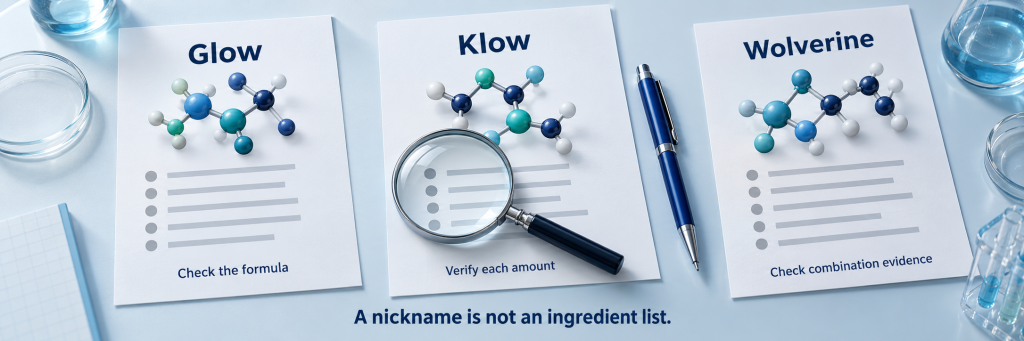
Glow Peptide
If you encounter a glow peptide or glow stack peptide listing, check the named components and quantities.
The supplied catalog includes a BPC-157, TB-500, and GHK-Cu blend. Its composition should be stated explicitly rather than inferred from a marketing nickname.
Klow Peptide
The catalog also includes a blend containing BPC-157, TB-500, GHK-Cu, and KPV.
For a klow peptide listing, verify whether that is the actual formula being offered. Searching for KPV peptide benefits also requires checking the evidence: a published KPV study investigated peptide transport and inflammation in cells and mouse models, rather than establishing treatment benefits in people. [5]
Wolverine Peptide Stack
The term wolverine peptide stack is commonly associated with BPC-157 and TB-500 combinations. Buyers should still confirm the actual formula.
Combining ingredients does not establish that they work better together. Evidence for individual components cannot establish the safety or effectiveness of a blend.
For laboratory experiments, combinations also make it harder to identify which component produced an observed response.
What About Peptides for Muscle Growth?
Searches for peptides for muscle growth often lead to CJC-1295 and ipamorelin discussions.

The key question is what the research measured.
A human CJC-1295 study investigated growth hormone and IGF-1 responses. Measuring a hormone change does not, by itself, demonstrate better muscle growth, strength, recovery, or long-term health. [6]
A credible comparison of the best peptides for muscle growth would need relevant outcomes and suitable comparison groups.
For research buyers, confirm the exact CJC-1295 variant. A DAC-containing molecule, a product labeled “No DAC,” and a blend with ipamorelin should not be assumed to reproduce the same study.
Research catalog variants: CJC-1295 DAC · CJC-1295 No DAC · CJC-1295 + Ipamorelin Blend · CJC-1295 No DAC + Ipamorelin Blend.
Peptide Side Effects: Why the Product Matters
There is no single list of peptide side effects that applies equally to every product.

Risk depends on the molecule, formulation, exposure, product quality, and individual circumstances.
FDA has raised safety concerns about several substances discussed in wellness markets, including BPC-157 and injectable GHK-Cu products. [4]
Three distinctions help when reading claims:
- Natural does not mean risk-free.
- A purity result does not establish safety for people.
- “Research use only” does not mean suitable for self-treatment.
This guide does not provide peptide dosages, injection instructions, or personal treatment recommendations.
What Should Research Buyers Check Before Ordering?
For laboratory procurement, move from the broad goal to the exact material required.
Look Beyond “High Purity Research Peptides”
The phrase high purity research peptides needs supporting information.
Ask what was tested, which method was used, and whether the result applies to the batch being supplied.
Purity and peptide content are different measurements. A chromatographic purity percentage should not automatically be read as the proportion of the vial’s total weight that is the intended peptide. [7]

Confirm These Details
| Purchase detail | What to verify |
|---|---|
| Molecular identity | Sequence, modifications, and chemical form where relevant |
| Quantity | Amount per vial, vials per pack, and what the stated amount represents |
| Blend composition | Identity and quantity of every component |
| Batch documents | COA matching the lot being supplied |
| Supporting analysis | Relevant identity and purity data |
| Experiment-specific requirements | Additional tests needed by the protocol |
| Handling | Storage, shipping, and available stability information |
If the product title, bottle image, and specification disagree, obtain clarification before ordering.
Where to Buy Peptides for Research?
When evaluating where to buy peptides for laboratory work, compare documentation and traceability alongside price.
The supplier should be able to explain what is being supplied and provide the information needed to assess its fit for the experiment.
The supplied catalog includes several compounds and blends discussed here. Their presence in the catalog does not establish that a particular batch matches a published study.
Frequently Asked Questions
Which Peptide Should I Choose for My Goal?
For a personal health goal, discuss treatment options with a licensed healthcare professional. For laboratory research, select the material according to the hypothesis, study methods, and specifications.
Are Weight Loss Peptides and Skin Peptides Interchangeable?
No. Different molecules interact with different biological targets. Even products containing the same named ingredient may differ in formulation and intended use.
Are Peptide Blends Better Than Individual Products?
Not automatically. A blend requires evidence for the combination, and it may complicate interpretation in a laboratory experiment.


Are All Products in a Peptide Catalog Peptides?
No. For example, NAD+ and Vitamin B12 are not peptides. A catalog category does not establish a molecule’s chemical identity.
Does a COA Prove That a Product Works?
No. A COA reports particular analytical results. It does not demonstrate clinical effectiveness or approval for human use.
Start With the Goal, Then Check the Evidence
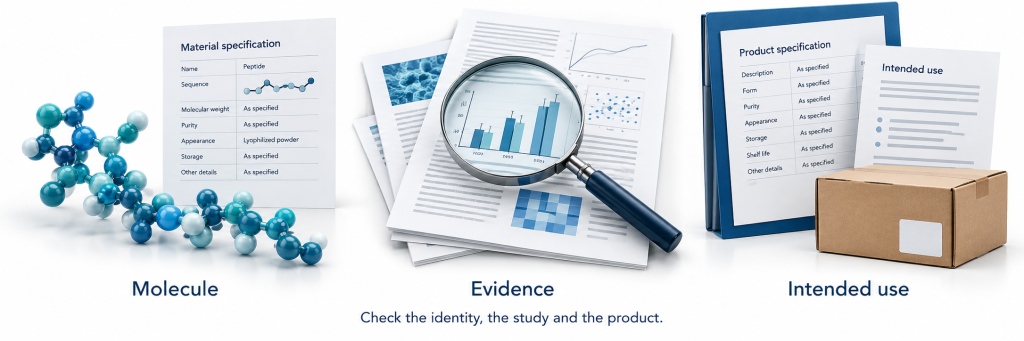
Weight loss, skincare, and recovery involve different questions. A useful comparison identifies the molecule, the evidence, the formulation, and the intended use.
For laboratory purchasing, add one more step: verify the exact specification and batch documentation before selecting a material.
Research-use products are intended for laboratory investigation, not for treating symptoms or medical conditions.
References
1. FDA. Safety communication identifying approved weight-reduction medicines.
2. Jastreboff AM, et al. Triple-Hormone-Receptor Agonist Retatrutide for Obesity—A Phase 2 Trial. New England Journal of Medicine. 2023.
3. Maquart FX, et al. Stimulation of collagen synthesis in fibroblast cultures by GHK-Cu. FEBS Letters. 1988.
4. FDA. Certain Bulk Drug Substances for Use in Compounding That May Present Significant Safety Risks.
5. Dalmasso G, et al. PepT1-mediated tripeptide KPV uptake reduces intestinal inflammation. Gastroenterology. 2008.
6. Teichman SL, et al. Prolonged stimulation of growth hormone and IGF-I secretion by CJC-1295 in healthy adults. Journal of Clinical Endocrinology & Metabolism. 2006.
7. Duncan K. CMC Regulatory Experiences and Expectations for Peptides. 2024 conference presentation; the author’s views, rather than FDA policy.