
Blog
GHK-Cu Peptide for Skin: Evidence, Copper Peptide Serums, and Research Limits

Does the GHK-Cu peptide actually help skin? Laboratory studies give scientists reasons to investigate it, and some human studies report improvements with products containing it. However, the human evidence reviewed here is limited, and it does not establish that every copper peptide serum will reduce wrinkles or improve skin recovery.
The important questions are what was tested, how the study was designed, and whether the findings apply to the product you are considering.
This guide explains GHK-Cu in plain English, reviews selected skin studies, and outlines what consumers and research buyers should check.
Key takeaways
- GHK-Cu is a small peptide bound to copper, commonly identified in cosmetics as Copper Tripeptide-1.
- Cell experiments and human skincare studies provide different kinds of evidence.
- Results from a multi-ingredient cream cannot establish the effect of GHK-Cu alone.
- A finished copper peptide serum and a research-use material are not interchangeable.
- Topical findings cannot establish the safety or effectiveness of injections.
What Is GHK-Cu? Understanding Copper Tripeptide-1
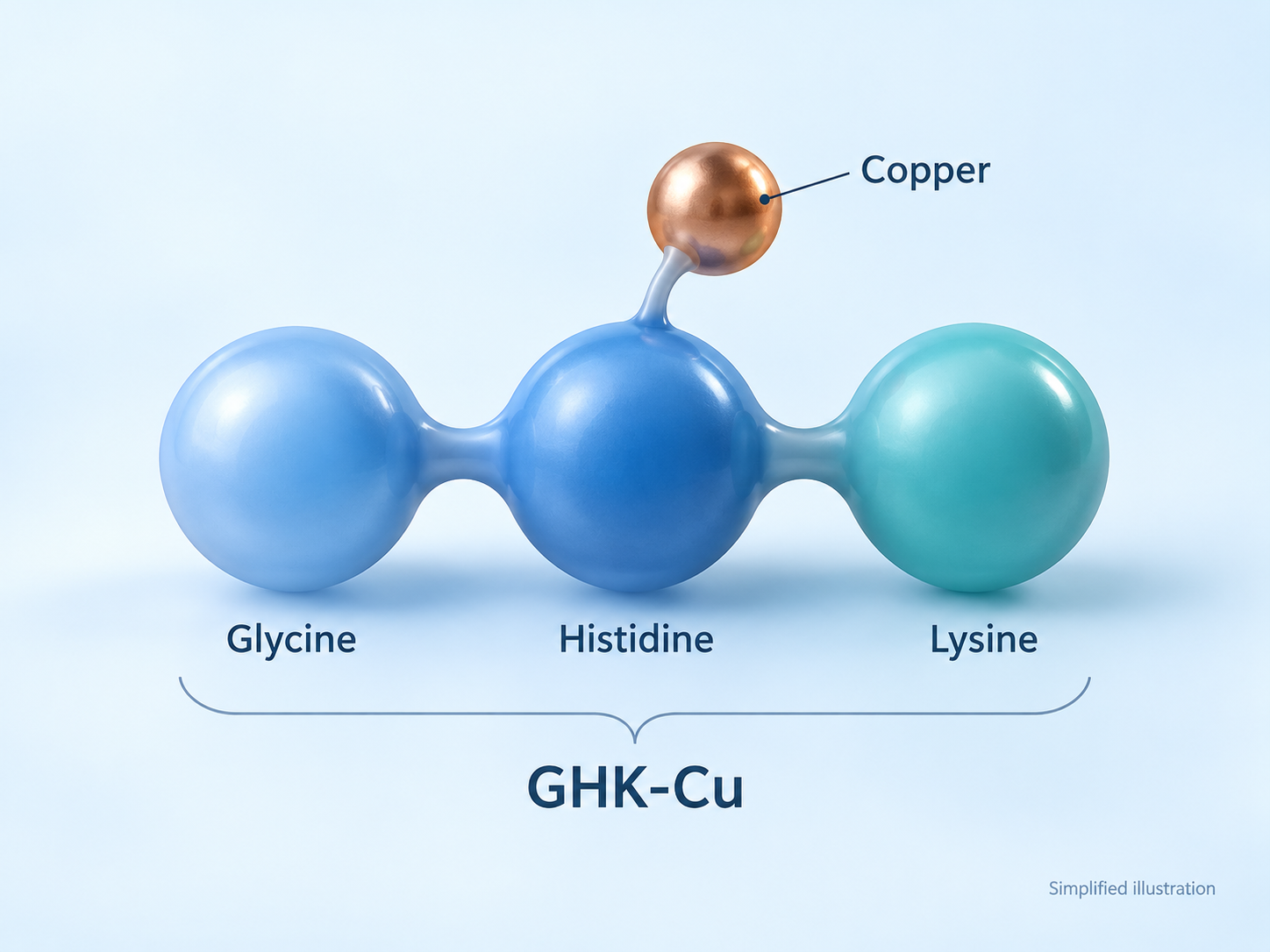
GHK is a peptide made from three amino acids: glycine, histidine, and lysine. When it forms a complex with copper, it is commonly called GHK-Cu.
In cosmetic ingredient terminology, Copper Tripeptide-1 is associated with this GHK copper complex. The Cosmetic Ingredient Review assessment discusses it alongside related peptide ingredients. [1]
| Name | Meaning |
|---|---|
| GHK | The three-amino-acid peptide |
| GHK-Cu | GHK complexed with copper |
| Copper Tripeptide-1 | The associated cosmetic ingredient name |
| Copper peptides | A broader description of copper-binding peptides |
You may encounter searches such as “GHK Cu peptide” or “copper peptide GHK-Cu.” These usually concern the same ingredient topic, but a product still needs to identify exactly what it contains.
GHK-Cu is not collagen. An ingredient being studied for effects on collagen-producing cells does not make it equivalent to collagen supplements.
GHK-Cu Benefits for Skin: What Does the Evidence Show?
Interest in GHK-Cu benefits for skin comes partly from experiments involving collagen and connective tissue.
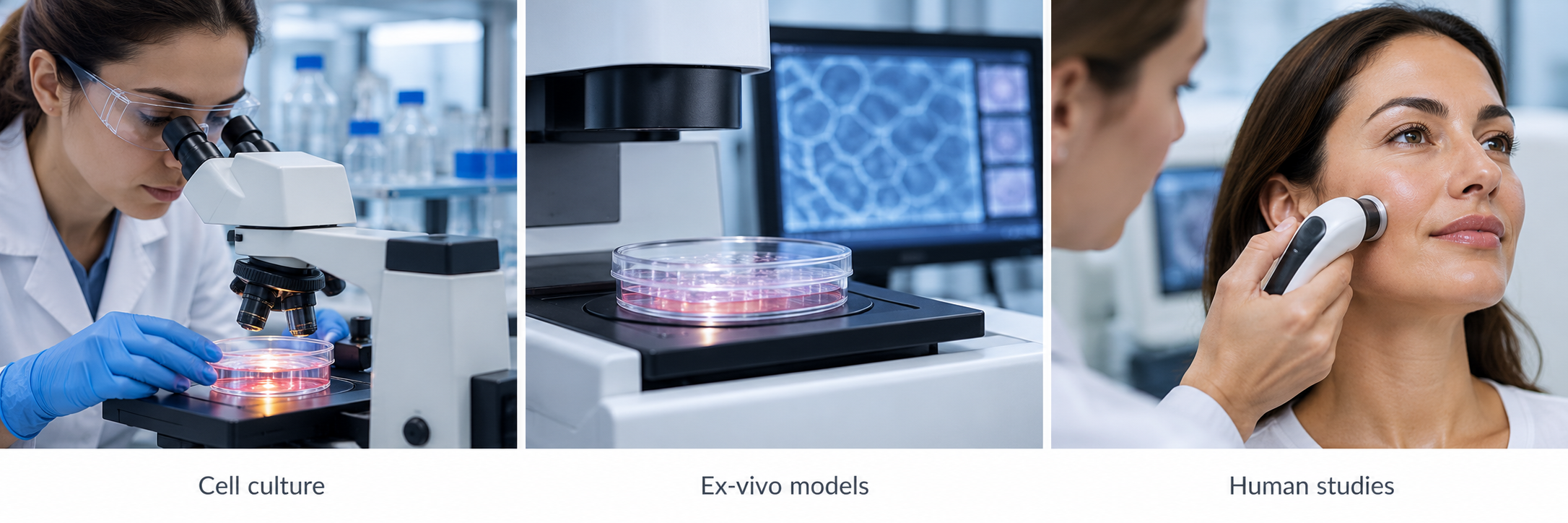
To understand those findings, distinguish three settings:
- Cell culture: Cells studied in a laboratory.
- Ex-vivo skin: Skin tissue studied outside the body.
- Human topical research: A formulation applied to participants.
The first two can help explain biological activity. Human studies are needed to investigate what happens when people use a particular formulation.
Selected Research Evidence
This is a selected evidence review, rather than a systematic review of every published study.
| Study and material | Main finding | What limits the conclusion? |
|---|---|---|
| 1988 fibroblast study: GHK-Cu tested on cultured connective-tissue cells. [2] | Increased collagen synthesis under the experimental conditions. | No human treatment participants or measurement of facial wrinkles. |
| 2023 laboratory study: GHK-Cu combined with hyaluronic acid in fibroblast and ex-vivo skin tests. [3] | Reported increased collagen IV production in the tested models. | Not a live-human skincare trial; the combination cannot validate every serum. |
| 2006 randomized post-laser study: Skincare regimens with or without GHK-Cu; 13 participants completed. [4] | No significant between-group advantage in objective assessments; patient satisfaction favored GHK-Cu. | Small sample and a specific CO2 laser recovery setting. |
| 2026 combination-cream study: 32 enrolled; outcome tables reported n=30 over 56 days. The cream contained 5% mixed ferment extract and 0.2% GHK-Cu. [5] | Reported improvements in several skin measurements compared with baseline. | No parallel human control group; the study could not isolate GHK-Cu’s contribution. |
The concentrations above describe a study formulation, not a recommended concentration for personal use.
Who Conducted the Research?
Research background is part of evaluating evidence.
The authors of the 2026 study were affiliated with a cosmetics company’s research and development center. They declared no conflicts of interest. Their affiliation does not invalidate the findings, but it is relevant context; the study should not be described as independent confirmation of GHK-Cu’s effects. [5]
What Can We Conclude?
The studies provide evidence of biological activity and observations about particular skincare formulations.
They do not establish a predictable result for every product containing the ingredient. The most useful evidence matches the actual formulation, intended use, and outcome being claimed.
Copper Peptides for Wrinkles, Texture, and Recovery
Fine Lines and Wrinkles
A cell producing more collagen does not tell us how much a person’s fine lines will change.
When evaluating copper peptides for wrinkles, look for human studies that explain the formulation, comparison group, measurement method, and follow-up period.
The 2026 study reported changes with a combination cream. Without a parallel control group, those changes cannot establish how much was caused by GHK-Cu, other ingredients, or other factors. [5]
Skin Texture and Firmness
“Better skin quality” can describe several different outcomes.
Ask whether researchers measured surface texture with an instrument, used a clinician’s assessment, or collected participant feedback. Each provides information, but satisfaction is not a direct measurement of collagen or skin structure.
Recovery After Cosmetic Procedures
The 2006 study examined skincare after CO2 laser resurfacing.
It found no significant objective advantage for the GHK-Cu regimen in redness resolution, wrinkles, or overall skin quality. Patient satisfaction was higher. [4]
This does not prove that all copper peptide products are ineffective. It also does not justify a general promise that they speed recovery after procedures.
For post-procedure care, follow the treating clinician’s instructions.
Copper Peptide Serum vs. Research-Use GHK-Cu
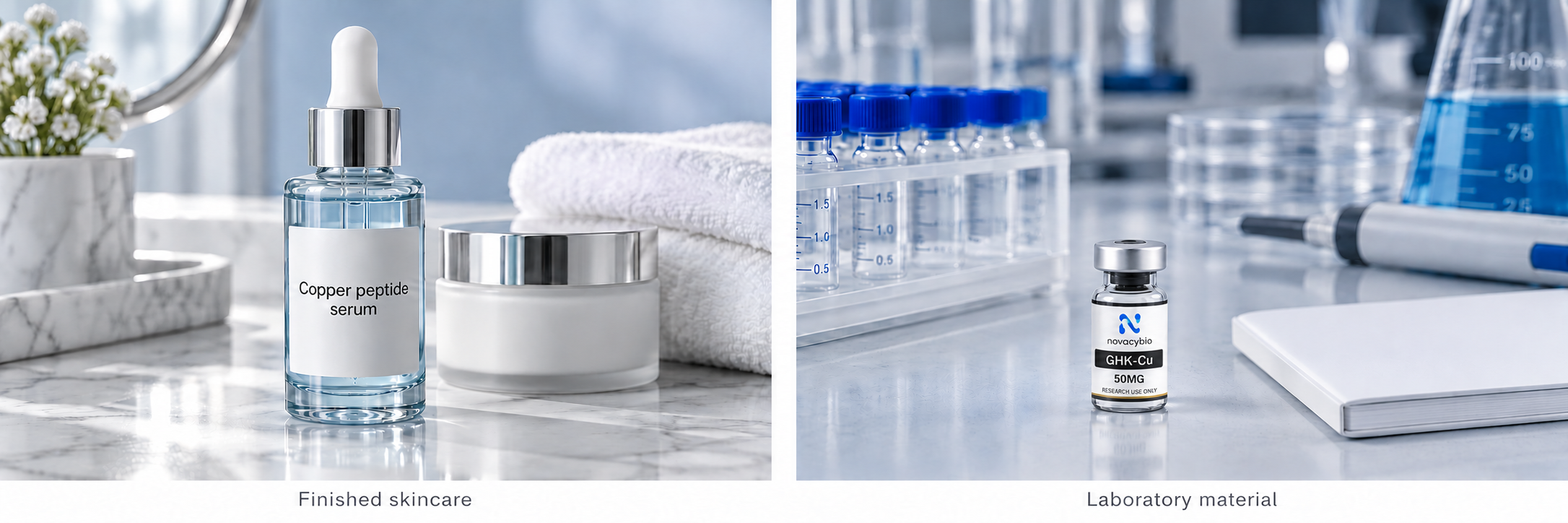
A copper peptide serum is a finished cosmetic formulation. A research-use GHK-Cu product is a material supplied for scientific investigation.
They may share an ingredient name, but they are evaluated for different purposes.
| Finished skincare product | Research-use material |
|---|---|
| Formulated for its stated cosmetic application | Supplied for a research context |
| Contains a complete ingredient system | May be supplied as a laboratory material |
| Should provide consumer directions | Requires specifications appropriate to the experiment |
| Needs evidence relevant to the finished formula | Needs documentation relevant to the supplied batch |
A study of a finished cream does not validate a separately sold research vial.
Research-use material should not be treated as a ready-to-use serum or as an ingredient for home skincare preparation.
How to Compare a Copper Peptide Serum
Check the Ingredient List
Look for the actual peptide identity.
“Multi-peptide” does not necessarily mean a product contains GHK-Cu. A general “copper complex” description should also be clarified rather than assumed to identify Copper Tripeptide-1.
Understand Percentage Claims
Check whether an advertised percentage refers to an individual ingredient or an ingredient blend.
Two percentages are not useful comparisons unless they describe the same thing. A higher number alone does not demonstrate better results.
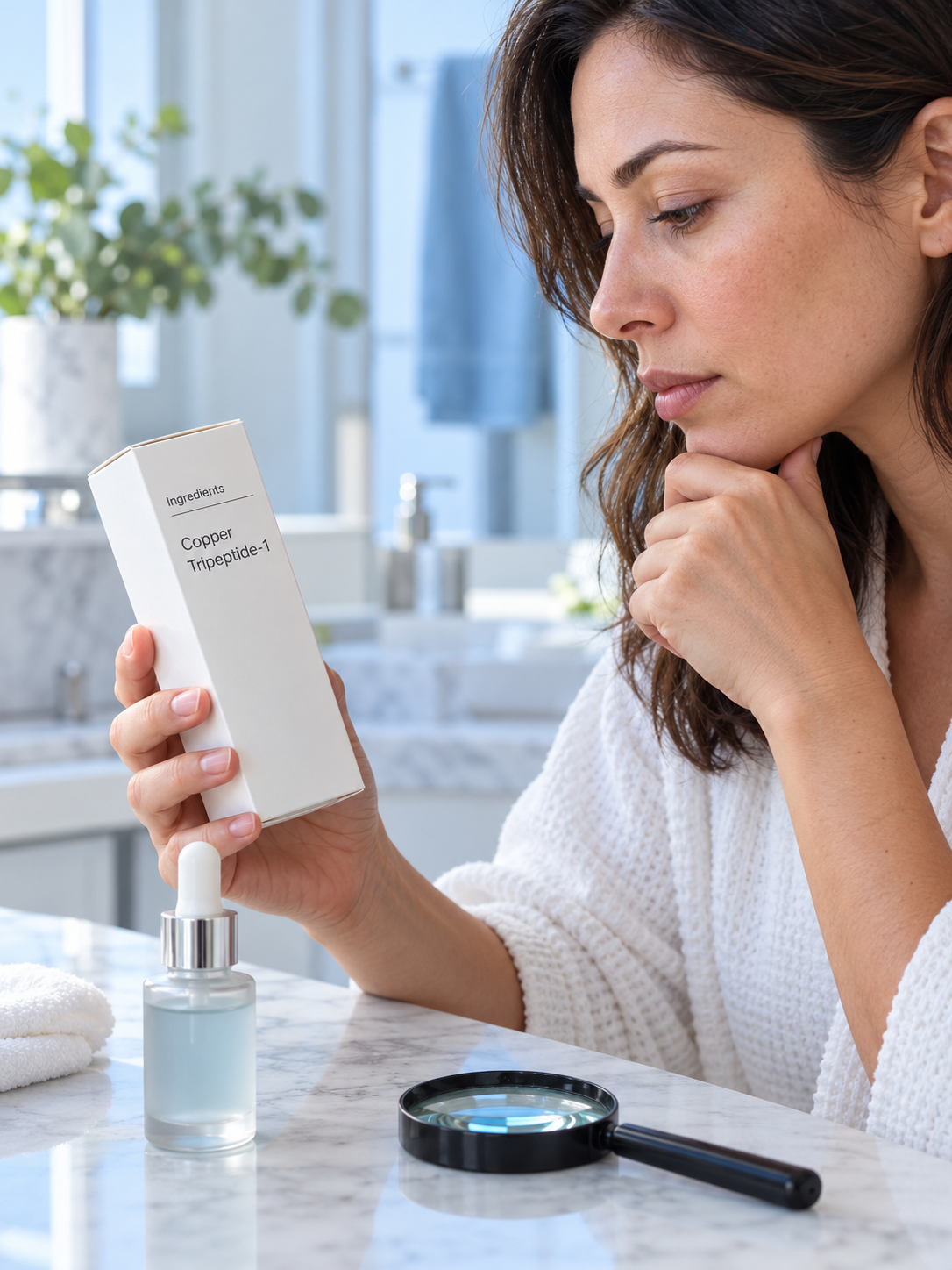
Look for Finished-Product Testing
Useful study information includes:
- How many people participated.
- Whether there was a comparison group.
- How long the study lasted.
- What researchers measured.
- Whether the tested formula matches the product being sold.
Ingredient research can explain why a formula was developed. It cannot establish the finished peptide serum’s performance by itself.
Consider the Whole Formula
Other ingredients can influence how a product feels and performs.
When a study evaluates a combination cream, improvements should be attributed to the tested formula unless the design can distinguish individual contributions.
Question Universal Promises
Claims such as “works for everyone,” “replaces cosmetic procedures,” or “has no side effects” deserve scrutiny.
Before-and-after images also need context, including consistent lighting and information about other treatments.
Copper Peptide Side Effects and Safety

Safety information needs to match the formulation and use.
The 2014 Cosmetic Ingredient Review panel concluded that the ingredients it assessed, including Copper Tripeptide-1, were safe under the cosmetic practices and concentrations described in that assessment. This was not a guarantee for every formula, concentration, or route. [1]
This selected review does not establish how frequently adverse reactions occur with every copper peptide serum. A product’s complete formulation also matters.
Follow the finished product’s directions. Stop using it and seek professional advice if you develop persistent irritation or another concerning reaction.
Does Topical Safety Support Injections?
No. Changing the route changes questions about exposure, formulation, and safety.
FDA separately identifies limited human safety information and potential immune-response concerns involving compounded injectable GHK-Cu. Cosmetic-use findings do not resolve those concerns. [6]
For Research Buyers: Specifications and Batch Documents
Laboratory buyers need different information from consumers comparing skincare.
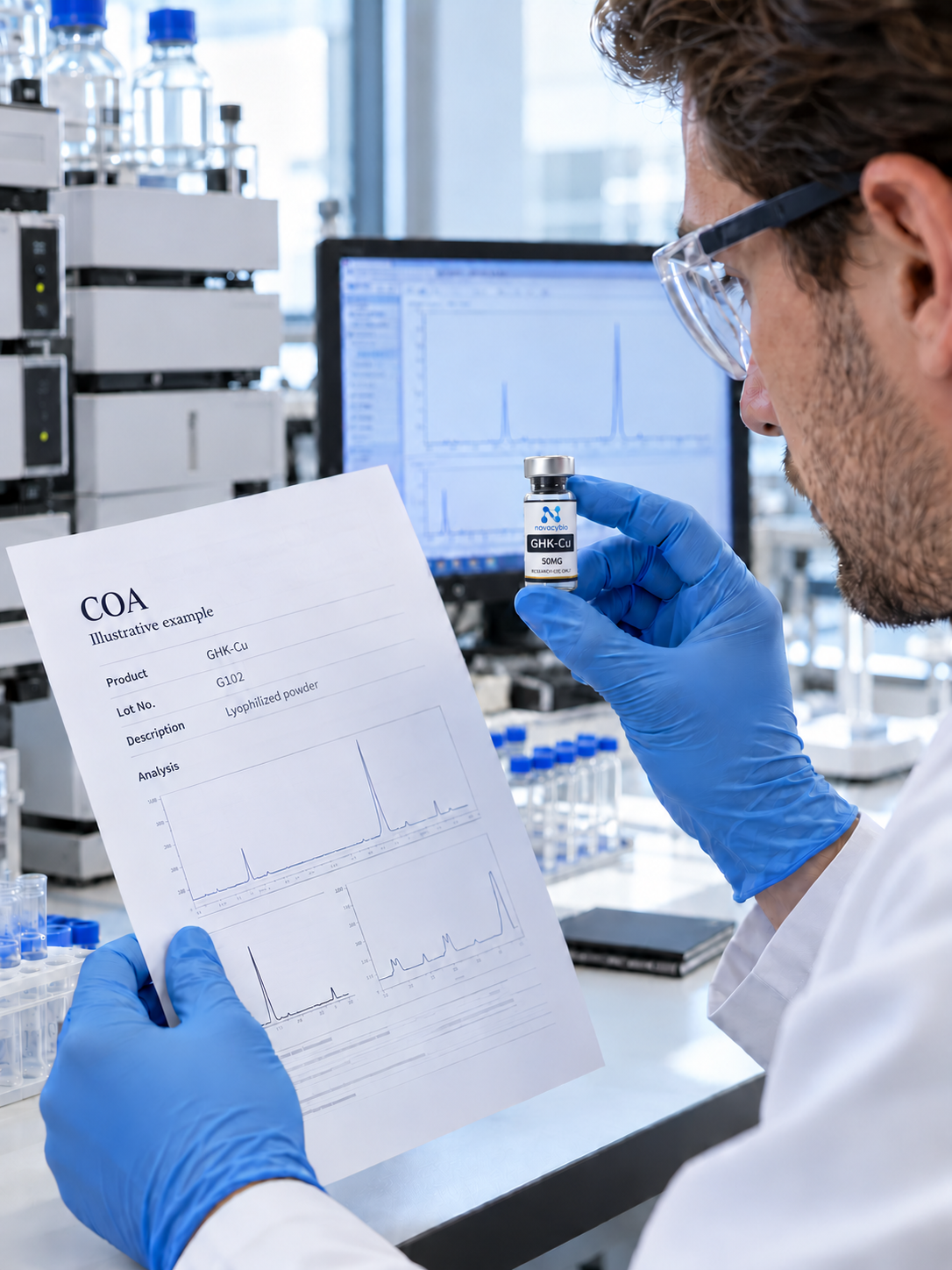
A certificate of analysis, or COA, reports specified test results for a material. It is most useful when its lot number matches the batch being supplied.
| Item | What to confirm |
|---|---|
| Identity | GHK-Cu rather than uncomplexed GHK or another copper peptide |
| Composition | The stated chemical form and copper-complex information |
| Quantity | Amount per vial, pack size, and what the stated amount represents |
| Batch documentation | COA matching the available lot |
| Analytical methods | Which tests support identity, purity, and content |
| Handling | Storage conditions and available stability information |
| Protocol requirements | Any additional tests needed for the experiment |
Purity and content answer different questions: how the material measures under a purity test is not automatically the same as how much intended peptide is present.
A COA also does not establish sterility, cosmetic suitability, or a clinical benefit.
Research materials and documentation inquiries: Contact the supplier for the current specification and batch documents, then compare them with the experimental protocol.
Frequently Asked Questions

Is GHK-Cu the Same as Copper Tripeptide-1?
Copper Tripeptide-1 is the cosmetic ingredient name associated with the GHK copper complex. Research buyers should still confirm the actual identity and composition.
Are Copper Peptides the Same as Collagen Peptides?
No. GHK-Cu is a specific copper-binding peptide complex. Collagen peptides are fragments derived from collagen.
Does a GHK-Cu Peptide Serum Remove Wrinkles?
The studies discussed here do not establish a guaranteed wrinkle-removal effect. Evaluate the evidence for the particular finished product.
Does Every Peptide Serum Contain GHK-Cu?
No. Peptide serums can contain different ingredients. Check the full ingredient list.
Can Topical GHK-Cu Research Support Injection Claims?
No. Topical studies cannot establish injection safety or benefits.
Can I Make a Serum From a Research Vial?
A research material is not a finished cosmetic product. Its identity and analytical results do not establish suitability for home skincare preparation.
How Long Does a Copper Peptide Serum Take to Work?
There is no universal timeline. Results depend on the formulation and the outcome measured. One study’s duration is not a promise for another product.
What to Take Away
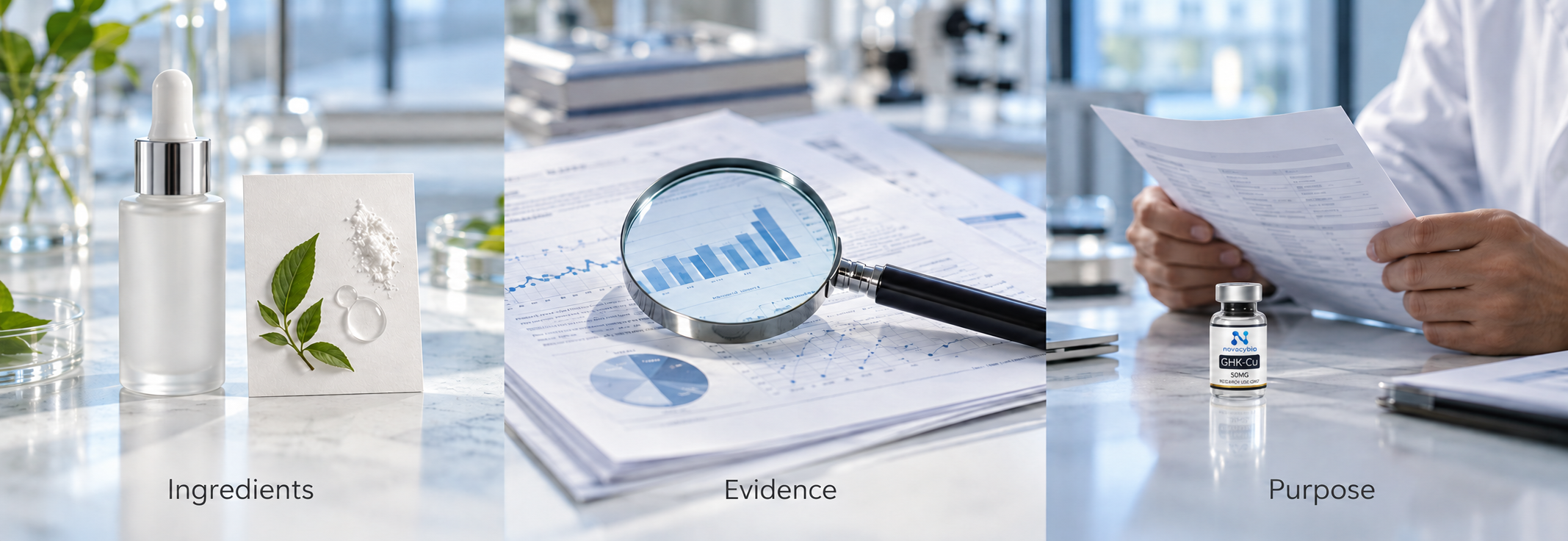
GHK-Cu is a scientifically interesting skin ingredient. Its laboratory findings and human studies need to be interpreted according to the actual formulation and research design.
For skincare, prioritize clear ingredients, relevant finished-product testing, and realistic expectations.
For laboratory research, assess the material’s identity, specifications, and batch documentation separately from cosmetic claims.
References
- Cosmetic Ingredient Review. Safety Assessment of Tripeptide-1, Hexapeptide-12, Their Metal Salts and Fatty Acyl Derivatives, and Palmitoyl Tetrapeptide-7 as Used in Cosmetics. 2014.
- Maquart FX, et al. Stimulation of collagen synthesis in fibroblast cultures by the tripeptide-copper complex glycyl-L-histidyl-L-lysine-Cu2+. FEBS Letters. 1988.
- Jiang F, et al. Synergy of GHK-Cu and hyaluronic acid on collagen IV upregulation via fibroblast and ex-vivo skin tests. Journal of Cosmetic Dermatology. 2023.
- Miller TR, et al. Effects of topical copper tripeptide complex on CO2 laser-resurfaced skin. Archives of Facial Plastic Surgery. 2006.
- Wang J, Tao K, Huang H, Chang H. Augmented Skin Beneficial Effects of Thermus Thermophilus and Bacillus Subtilis Mixed-Culture Ferment Extract by Tripeptide GHK-Cu. Skin Research and Technology. 2026;32(8).
- FDA. Certain Bulk Drug Substances for Use in Compounding That May Present Significant Safety Risks.