
Blog
MOTS-c Peptide: Potential Benefits, How It Works, and Research Evidence


The MOTS-c peptide is drawing scientific interest for its role in glucose regulation, exercise adaptation, and the maintenance of physical function with age.
What makes it particularly interesting is its connection to mitochondrial signaling. Mitochondria help supply cellular energy, but they also send signals that influence how cells respond to changing demands. MOTS-c offers researchers a way to investigate that communication.
Studies have reported metabolic and physical-performance benefits in experimental models, while human research has revealed relationships with exercise and muscle biology.
Here is a closer look at the most promising findings, how MOTS-c works, and what those results mean.
What Is MOTS-c?
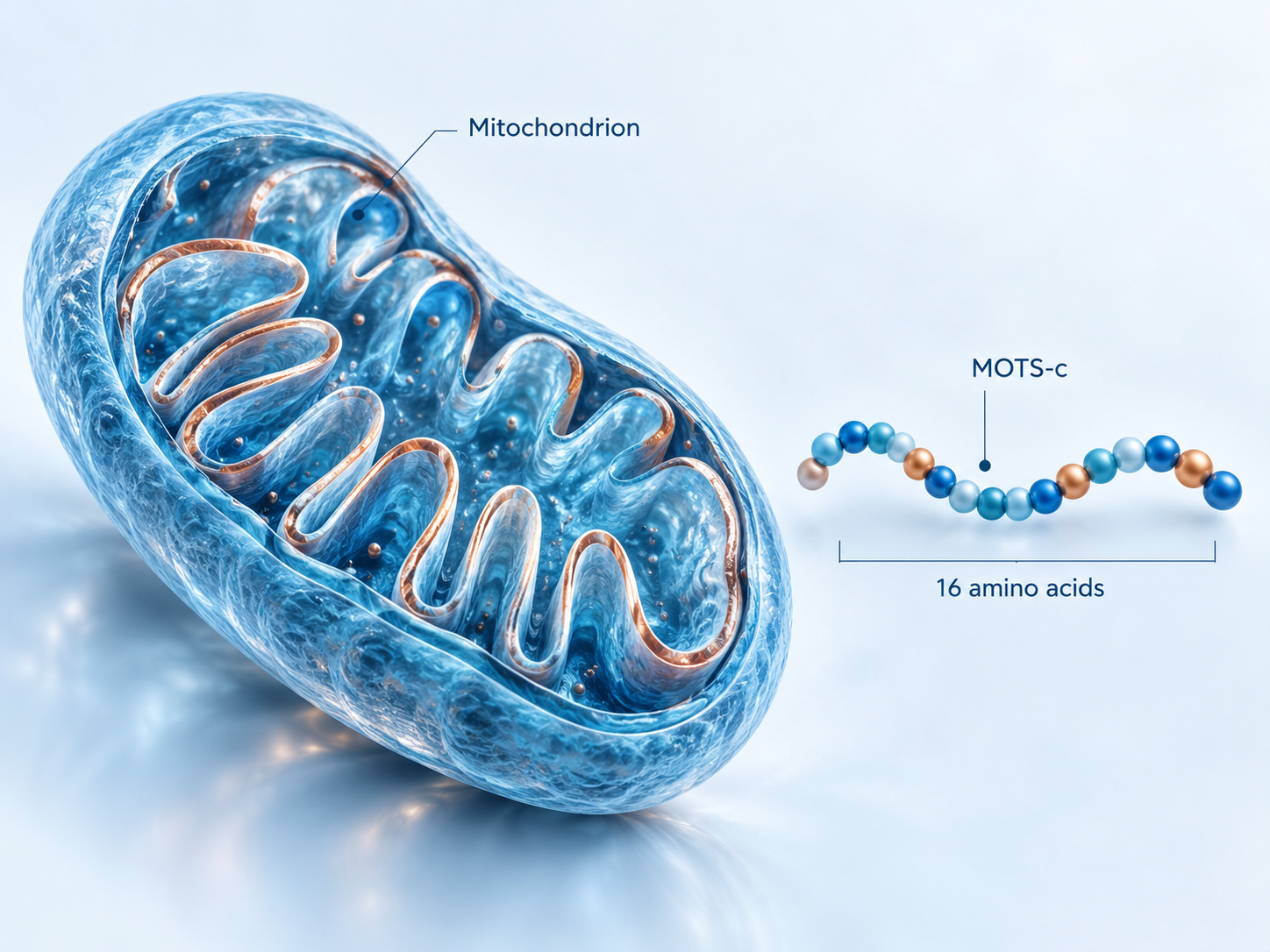
MOTS-c is a 16-amino-acid mitochondrial-derived peptide. Its name stands for mitochondrial open reading frame of the 12S rRNA-c.
The discovery study identified its coding sequence within mitochondrial DNA and investigated its influence on metabolic regulation. 1
Unlike a structural protein that helps build tissue, MOTS-c is studied as a signaling molecule: something that can influence cellular activity.
Researchers examine both the body’s naturally occurring MOTS-c and synthetic material used in experiments. These approaches reveal different aspects of its biology.
Potential MOTS-c Benefits at a Glance
| Research direction | Representative findings | Evidence setting |
|---|---|---|
| Glucose regulation | Improved insulin sensitivity and muscle glucose handling | Cell and mouse studies |
| Fat metabolism | Reduced diet-induced weight gain and changes in fuel use | Mouse studies |
| Exercise performance | Improved treadmill performance; exercise-associated endogenous changes | Mouse interventions and human exercise measurements |
| Physical function with age | Improvements in selected performance tests in older animals | Mouse studies |
| Cellular adaptation | Stress-responsive gene regulation and metabolic signaling | Mechanistic experiments |
These findings describe research outcomes rather than guaranteed effects in people. Their value lies in identifying specific biological processes that can be investigated further.
How Does MOTS-c Work?
Helping Coordinate Cellular Energy Responses
One important part of MOTS-c research involves AMPK, a protein that helps cells respond to changes in energy availability.
Early experiments linked MOTS-c to changes in folate and purine metabolism that led to AMPK activation. 1
This provides a possible connection between mitochondrial signals and the way cells manage nutrients.
Connecting Metabolism With Muscle Function
Later research identified CK2, a protein kinase, as a direct functional target of MOTS-c.
In experimental systems, MOTS-c bound to CK2. In mice, suppressing CK2 activity weakened certain MOTS-c-associated effects on muscle glucose uptake and muscle maintenance. The study also reported tissue-specific responses. 2
These findings add detail to how MOTS-c may influence metabolism. They suggest that its activity involves coordinated, context-dependent signaling rather than a simple increase in energy production.

Potential Benefit 1: Glucose Regulation and Insulin Sensitivity
Insulin helps tissues respond to glucose in the bloodstream. When those responses become less effective, the body may need more insulin to manage the same glucose supply.
MOTS-c attracted early attention because treatment in mice improved insulin sensitivity associated with aging and high-fat feeding. Skeletal muscle was an important tissue in those experiments. 1
That makes MOTS-c relevant to questions such as:
- How does muscle adjust its glucose uptake?
- Which signals help maintain metabolic balance under nutritional stress?
- How do age-related changes affect those responses?
The CK2 study adds another experimental connection: MOTS-c administration enhanced muscle glucose uptake in mice, with CK2 activity contributing to that effect. 2
For researchers, this creates a useful bridge between molecular mechanisms and measurable metabolic outcomes.

Potential Benefit 2: Fat Metabolism and Flexible Energy Use
Body Weight and Fat Accumulation
The original research reported that MOTS-c treatment prevented diet-induced obesity in mice. 1
This finding helped establish interest in MOTS-c as a metabolic research peptide. It concerns how an organism responds to a defined dietary challenge, rather than simply whether a compound makes body weight fall.
That distinction can guide more informative experiments involving body composition, glucose handling, and energy expenditure.
Metabolic Flexibility
Metabolic flexibility is the ability to adjust fuel use as conditions change.
For example, the balance between carbohydrate and fat use changes with feeding, activity, and rest.
In older mice, researchers investigated respiratory exchange ratio—a measurement related to fuel preference—and reported MOTS-c-associated changes in daily fuel-use patterns. 3
This makes metabolic adaptability, rather than a vague promise to “boost metabolism,” one of the more interesting directions for MOTS-c research.

Potential Benefit 3: Exercise Adaptation and Physical Performance
MOTS-c Responds to Exercise in People
A 2021 study measured MOTS-c around a cycling session in 10 young men.
Endogenous MOTS-c increased in skeletal muscle and circulation. Blood levels returned toward baseline after rest. Participants were exercising, not receiving the peptide. 3
The finding places MOTS-c within the body’s response to physical activity and helps explain interest in it as an exercise-responsive signal.
Performance Findings in Mice
A separate 2022 study examined both exercise-related changes and administered MOTS-c.
In one experiment, a single administration improved running time by approximately 12% and running distance by 15% during an acute treadmill test in untrained mice.
The researchers also observed increased muscle MOTS-c expression after voluntary running. 4
These results connect MOTS-c exercise research with practical experimental endpoints: duration, distance, and muscle responses.
Why It Is Sometimes Called an Exercise Mimetic
An exercise mimetic reproduces selected biological responses associated with exercise.
For MOTS-c, that description reflects interest in overlapping metabolic signals and performance findings in animals. It does not mean that the peptide reproduces the complete effects of physical training.
The scientific opportunity is to understand which adaptations overlap—and which remain distinct.

Potential Benefit 4: Physical Function and Cellular Adaptation With Age
Maintaining Physical Capacity
Healthy-aging research often examines function: the ability to move, maintain strength, and respond to physical demands.
The 2021 MOTS-c study reported improvements in selected physical-performance measurements in older mice, including experiments initiated late in life. 3
This makes maintenance of function a more precise research theme than a general “anti-aging” claim.
Age-Related Biology Is More Complex Than a Blood Level
A human study found lower circulating MOTS-c with age, but higher skeletal-muscle expression in middle-aged and older men than in younger men. Muscle expression was also associated with muscle-fiber characteristics. 5
This suggests that MOTS-c regulation differs between blood and tissue.
Understanding those differences may help researchers ask better questions about muscle quality and aging. It does not support treating one circulating measurement as a universal marker of deficiency.
Adapting to Cellular Stress
Cells need to adjust when nutrients become limited or oxidative stress increases.
A 2018 study found that MOTS-c could move into the nucleus during metabolic stress and influence gene activity. Its interactions involved stress-responsive factors such as NRF2. 6
This gives MOTS-c research a broader focus than energy supply alone: how cells change their behavior to cope with challenging conditions.

What Do Human Studies Show?
The most important distinction is between measuring endogenous MOTS-c and administering MOTS-c as an intervention.
Human studies have investigated exercise responses, age-related patterns, and associations with metabolic indicators.
For example, a study of 10 lean and 10 obese participants found similar circulating concentrations between groups. Associations with insulin-resistance measures were mainly present in lean participants, illustrating that the relationship is not simply “more is better.” 7
In the targeted searches supporting this article, no peer-reviewed human intervention report was identified that establishes native MOTS-c benefits for fat loss, endurance, or healthy aging.
FDA’s May 2026 review also reported that it had not identified clinical studies evaluating administration of MOTS-c-related substances to humans. That finding reflects the review’s evidence cutoff. 8
What About CB4211?
CB4211 is a modified analogue related to MOTS-c. CohBar described its early clinical development in corporate filings. 9
Its findings belong to that investigational molecule. They should not be presented as direct clinical evidence for native MOTS-c.
The current research opportunity is clear: connect the promising experimental biology with well-designed human studies and meaningful outcomes.

Frequently Asked Questions
What Are the Main Potential MOTS-c Benefits?
The strongest themes in the research reviewed here are glucose regulation, metabolic adaptation, exercise-related biology, and physical function. Much of the intervention evidence comes from experimental models.
Does MOTS-c Have Potential Benefits for Fat Metabolism?
Yes, animal findings make fat metabolism a relevant research direction. Establishing a human treatment benefit requires direct human intervention evidence.
Is MOTS-c the Same as a GLP-1 Peptide?
No. MOTS-c is a mitochondrial-derived peptide. GLP-1 refers to glucagon-like peptide-1, a different peptide system.
How Does MOTS-c Differ From SS-31?
MOTS-c research emphasizes metabolic signaling and adaptation. SS-31, or elamipretide, has been investigated for interactions with cardiolipin in the mitochondrial inner membrane. 10
The shared mitochondrial connection does not make them interchangeable.
Has MOTS-c Been Proven to Extend Human Lifespan?
No. Physical-function findings in animals and age-related observations in people do not establish longer human life.
Why Is MOTS-c Interesting to Researchers?
It connects mitochondrial biology with measurable questions about glucose uptake, fuel use, exercise responses, and stress adaptation. That combination offers several defined directions for further investigation.

Why MOTS-c Remains a Valuable Research Topic

MOTS-c offers a distinctive way to investigate how mitochondrial signals influence metabolism and physical function.
Its appeal comes from concrete findings: improved glucose handling in experimental models, exercise-responsive endogenous changes in people, and performance outcomes in animals. Together, these findings provide a foundation for further mechanistic and translational research.
Explore Novacybio’s MOTS-c research material specifications, or contact us for available product and batch documentation.
References
- Lee C, et al. The mitochondrial-derived peptide MOTS-c promotes metabolic homeostasis and reduces obesity and insulin resistance. Cell Metabolism. 2015.
- MOTS-c modulates skeletal muscle function by directly binding and activating CK2. Original research.
- Reynolds JC, et al. MOTS-c is an exercise-induced mitochondrial-encoded regulator of age-dependent physical decline and muscle homeostasis. Nature Communications. 2021.
- MOTS-c increases in skeletal muscle following long-term physical activity and improves acute exercise performance after a single dose. Original research. 2022.
- D’Souza RF, et al. Increased expression of the mitochondrial derived peptide, MOTS-c, in skeletal muscle of healthy aging men is associated with myofiber composition. Aging. 2020.
- Kim KH, et al. The Mitochondrial-Encoded Peptide MOTS-c Translocates to the Nucleus to Regulate Nuclear Gene Expression in Response to Metabolic Stress. Cell Metabolism. 2018.
- Cataldo LR, et al. Plasma MOTS-c levels are associated with insulin sensitivity in lean but not in obese individuals. Journal of Investigative Medicine. 2018.
- FDA. Evaluation of MOTS-c-Related Bulk Drug Substances. Review dated May 11, 2026, prepared for the July 2026 advisory committee meeting.
- CohBar. 2021 Form 10-K. Corporate description of CB4211.
- Birk AV, et al. Targeting mitochondrial cardiolipin and the cytochrome c/cardiolipin complex to promote electron transport and optimize mitochondrial ATP synthesis. British Journal of Pharmacology. 2014.
This article reviews selected studies rather than providing a systematic review. Sources were reviewed on October 26, 2026.