
Blog
Peptide Stacks Explained: Glow, Klow, and Wolverine Compared


For research procurement, the main difference between Glow, Klow, and Wolverine peptide stacks is their stated composition.
Glow commonly refers to BPC-157, TB-500, and GHK-Cu. Klow commonly adds KPV. Wolverine often describes a BPC-157 and TB-500 pairing. These naming patterns appear in supplier descriptions, but they are not standardized specifications. 1
A purchasing decision requires the exact material identities, individual quantities, packaging, and batch documentation—not just the blend name.
This guide compares those details and explains how to assess the evidence before requesting a quotation for research materials.
Buyer’s quick summary
- Confirm the formula behind each name.
- Distinguish a single-vial blend from a kit of separate materials.
- Check the quantity of every component and its reporting basis.
- Resolve TB-500 identity before comparing it with published research.
- Request documentation for the final material being supplied.
- Evaluate combination evidence separately from ingredient evidence.
What Is a Peptide Stack—and Is It Always a Blend?
“Peptide stack” is an informal description of multiple peptides discussed or considered together. It does not establish how the materials are supplied.
For procurement, distinguish these formats:
| Format | What the buyer needs to establish |
|---|---|
| Single-vial blend | Which components are mixed together and the quantity of each |
| Multi-vial kit | Contents of every vial and the number of containers |
| Bundle of individual materials | Separate specifications and batch documents for each item |
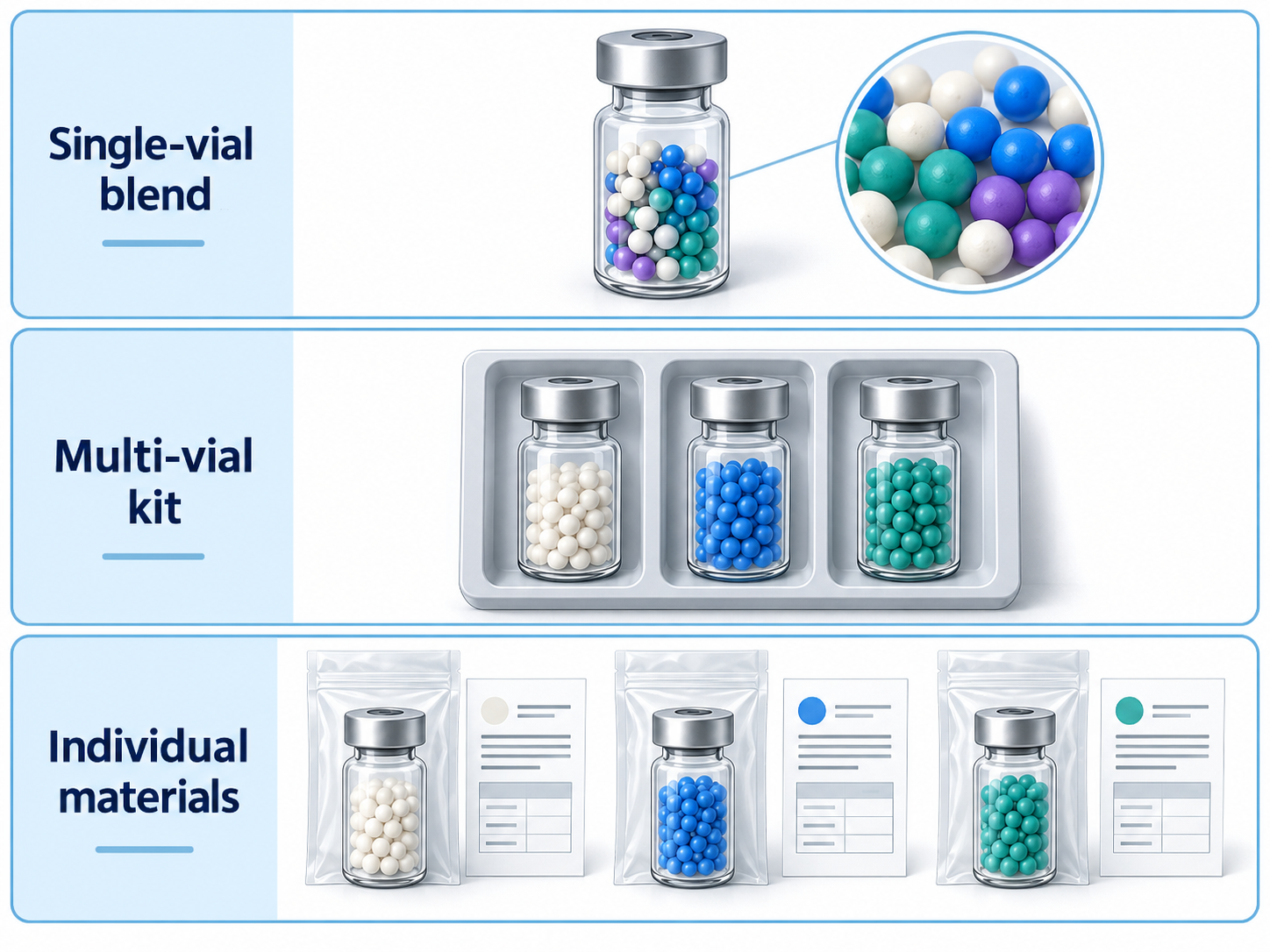
A photograph showing several vials cannot establish whether they contain identical blends or different individual materials.
The format also affects experimental flexibility. A fixed blend links the components in a stated ratio, while separately supplied materials allow the research team to select inputs independently.
Neither format is universally preferable. The study design determines what is appropriate.
Glow vs. Klow vs. Wolverine: Composition Comparison
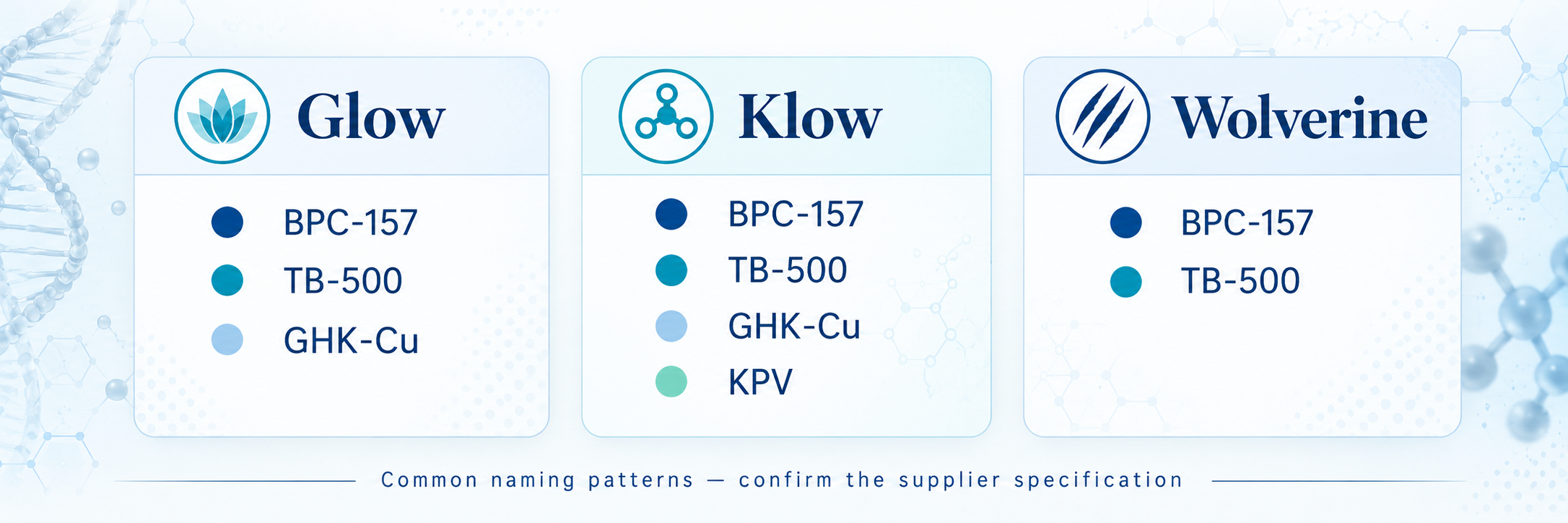
The following table describes common naming patterns documented in supplier material. It does not confirm the composition of every product using these names. 1
| Common name | Frequently listed components | Main procurement question |
|---|---|---|
| Glow peptide blend | BPC-157 + TB-500 + GHK-Cu | Are all three identities and quantities documented? |
| Klow peptide blend | BPC-157 + TB-500 + GHK-Cu + KPV | Is KPV included, and is every component quantified? |
| Wolverine peptide stack | BPC-157 + TB-500 | Which TB-500 material is supplied, and what is the ratio? |
Do not assume equal ratios, identical vial strengths, or equivalent packaging across suppliers.
A total blend weight also cannot establish the amount of each ingredient. Two products with the same total weight may have different compositions.
What Should Buyers Verify About Each Component?
BPC-157
Confirm the sequence, relevant chemical form, and identification evidence.
Experimental BPC-157 research includes work on tendon-derived cells, migration, and survival under stress. Such findings describe specific models rather than the performance of a commercial blend. 2
TB-500
TB-500 requires particular attention because a product name alone is not a sufficient molecular specification.
A 2012 analytical study identified the acetylated thymosin beta-4 fragment Ac-LKKTETQ in material called TB-500. 3

That finding does not identify every product sold under the name. It highlights why buyers should request:
- The full amino acid sequence.
- Terminal modifications.
- Expected molecular mass.
- The basis of any salt or acetate description.
- Supporting batch identification data.
A thymosin beta-4 fragment should not be assumed equivalent to the full-length molecule.
GHK-Cu
Confirm that the stated material is the copper complex rather than uncomplexed GHK.
Research on GHK-Cu includes fibroblast experiments examining collagen synthesis. Those results cannot establish the performance of a three- or four-component mixture. 4
For material selection, check the specification’s description of composition and any copper-related characterization relevant to the protocol.
KPV
Confirm its inclusion and individual quantity in a Klow listing.
KPV research includes cell models and mouse experiments involving peptide transport and intestinal inflammation. 5
Adding it changes the formula. It does not establish that the resulting blend is stronger, more comprehensive, or better suited to an experiment.
Does Ingredient Research Validate a Peptide Blend?
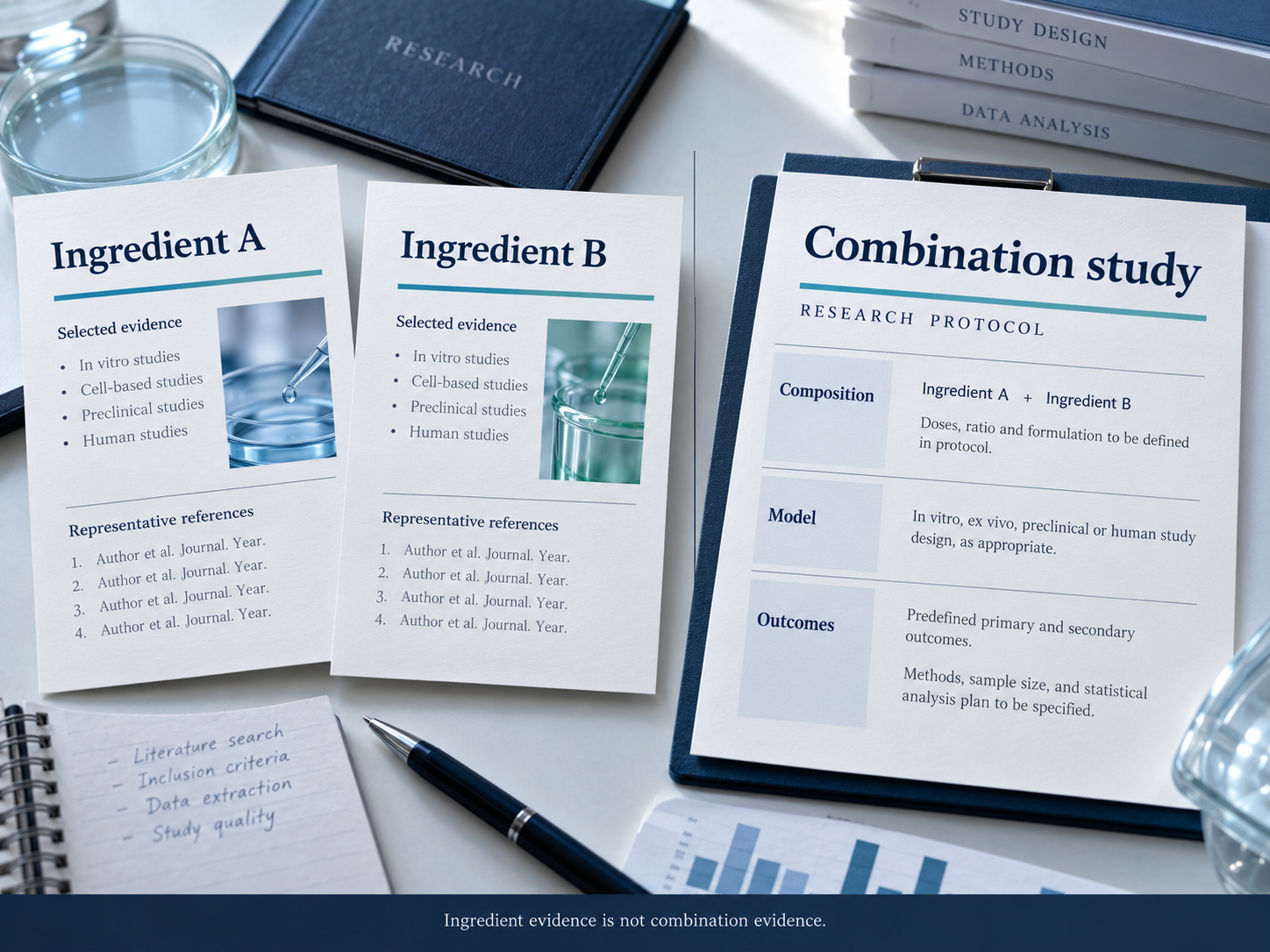
No. A mixture requires evaluation as a mixture.
Before connecting a paper to a product, compare the exact molecules, proportions, formulation, experimental model, exposure conditions, and measured outcomes.
Mechanistic explanations can justify a hypothesis. They cannot demonstrate synergy by themselves.
Direct BPC-157 and TB-500 Combination Research
A 2026 rat Achilles tendon study included control, BPC-157, TB-500, and combination groups.
Thirty-two rats were allocated across four groups. Within each group, four tendons were assigned to biomechanical testing and four to histological analyses.
The combination did not demonstrate additional benefit over either component alone under the tested conditions. 6
This is direct combination research, but it does not validate every BPC-157 TB-500 blend or establish human effectiveness.
A 2021 retrospective report also examined BPC-157 alone or combined with material described as thymosin beta-4 for knee pain. Its uncontrolled design and material-description limitations prevent it from validating a commercial Wolverine formulation. 7
Evidence for Glow and Klow
In the targeted searches conducted for this article, no controlled human trial was identified that directly validates the three- or four-component formulas described here.
This is a search finding, not a claim that no unpublished or unindexed work exists.
For procurement, the practical question remains: Does the supplied composition match the material required by the experimental protocol?
How to Compare Peptide Blend Specifications
1. Write the Formula in Full
Use the component names in purchasing records rather than relying on Glow, Klow, or Wolverine alone.
Include the relevant molecular specifications so that similarly named materials are not treated as interchangeable.
2. Establish the Quantity Basis
Confirm whether each amount is:
- Per vial.
- Per kit.
- Per complete package.
- A nominal fill quantity.
- An analytically determined component quantity.
Also establish whether the stated mass includes counterions or other material.
Resolve discrepancies between product titles, bottle images, specifications, and quotations before ordering.

3. Define the Ratio
Ask whether the ratio is mass-based or molar.
Equal masses of different peptides do not necessarily represent equal numbers of molecules. A ratio without a defined basis is incomplete.
4. Review Final-Blend Testing
COAs for starting ingredients do not establish the composition of the final mixture.
Request information about how the finished blend is identified and quantified. A single chromatographic purity percentage cannot confirm the correct amount of every component.
EMA’s synthetic-peptide guideline distinguishes identification, assay, and impurity analysis. Its medicinal-product scope informs these analytical concepts but does not certify a research supplier. 8
5. Connect the Documents to the Supplied Lot
A certificate of analysis, or COA, should be traceable to the material being offered.
Determine whether the supporting report concerns:
- Individual starting ingredients.
- A bulk blend.
- The filled product.
- A separately submitted sample.
If identifiers differ, request the documented relationship between them.
6. Check Storage and Stability Information
Ask which data support the actual mixture and packaging.
Information about individual ingredients does not automatically establish stability after blending, filling, shipping, or storage.
Avoid assuming compatibility or incompatibility solely from a general ingredient description.
Procurement Checklist
| Item | Information to request |
|---|---|
| Formula | Full component list and molecular identities |
| Quantity | Individual amounts and reporting basis |
| Packaging | Vial count, pack size, and contents of each container |
| Ratio | Defined mass or molar basis |
| Batch records | Connection between supplier lot, laboratory sample, and supplied stock |
| Analytical evidence | Component identification, quantification, and relevant impurity data |
| Handling | Storage conditions and available stability information |
| Supply terms | Minimum order, availability, lead time, and discrepancy process |
How to Request Comparable Quotations

Comparing prices is easier when suppliers quote against the same requirements.
Provide the intended laboratory context and request:
- The full composition rather than the blend nickname alone.
- Confirmed quantities per vial and per package.
- The specification and available batch COA.
- Supporting chromatograms, spectra, or component-assay reports.
- Relevant storage and stability information.
- Available quantity, minimum order, and lead time.
- Details of any additional testing or customization available.
Compare equivalent compositions and documentation scopes. A lower package price may concern a different quantity, ratio, or testing package.
For repeat procurement, keep the accepted specification and batch documents with the purchasing record so that future lots can be assessed consistently.
Frequently Asked Questions
Are Glow and Klow the Same Blend?
Not in the common naming pattern described here. Klow adds KPV to BPC-157, TB-500, and GHK-Cu. Confirm the actual supplier formula.
Is a Wolverine Peptide Stack Always Supplied in One Vial?
No. The term does not establish packaging. Ask whether the listing is a premixed blend or a kit of separate materials.
Does Adding More Peptides Mean Better Results?
No. More components increase the number of variables. Their usefulness depends on the research question and supporting evidence.

Is TB-500 Always the Same Material?
Do not assume so. Compare the sequence, modifications, molecular mass, and identity data.
Can One Purity Result Confirm the Whole Blend?
Not by itself. The method must support the conclusion being claimed. Component identity, relative purity, and individual quantity are separate questions.
Can a COA Establish Safety or Effectiveness for Human Use?
No. Analytical documentation does not substitute for clinical evidence or regulatory approval.
Which Blend Is Best for Laboratory Research?
The appropriate composition follows from the protocol. Define the required components and controls before choosing a fixed blend or separate materials.
Compare the Formula, Then Request the Documents
Glow, Klow, and Wolverine can help locate product listings. They do not replace specifications.
For B2B evaluation, compare identity, individual quantities, packaging, batch documentation, and the evidence relevant to the experiment.
When requesting research materials, use the full component names and ask for the documents associated with the batch available for supply.
For laboratory procurement, review the individual BPC-157, TB-500, GHK-Cu, KPV specifications and request current batch documentation. Confirm the final supplied composition and packaging separately.
Sources and Scope
This article compares research-material naming, composition, evidence, and procurement considerations. It is not a systematic review or a guide to human use.
The supplier reference supports naming examples only; it is not used as independent evidence of effectiveness.
- GenoPept. Peptide Blends Explained: Wolverine, GLOW and KLOW.
- Chang CH, et al. The promoting effect of pentadecapeptide BPC 157 on tendon healing involves tendon outgrowth, cell survival, and cell migration. Journal of Applied Physiology. 2011.
- Esposito S, et al. Synthesis and characterization of the N-terminal acetylated 17–23 fragment of thymosin beta 4 identified in TB-500. Drug Testing and Analysis. 2012.
- Maquart FX, et al. Stimulation of collagen synthesis in fibroblast cultures by the tripeptide-copper complex glycyl-L-histidyl-L-lysine-Cu2+. FEBS Letters. 1988.
- Dalmasso G, et al. PepT1-mediated tripeptide KPV uptake reduces intestinal inflammation. Gastroenterology. 2008.
- Biçer O, et al. Effects of BPC-157 and TB-500 on Achilles tendon healing in rats: A histopathological and biomechanical study. Joint Diseases and Related Surgery. 2026;37(3):822–837.
- Lee E, Padgett B. Intra-Articular Injection of BPC 157 for Multiple Types of Knee Pain. Alternative Therapies in Health and Medicine. 2021.
- EMA. Guideline on the Development and Manufacture of Synthetic Peptides.