
Blog
Retatrutide vs. Semaglutide: What the New Ozempic Trial Revealed



An 80-week trial comparing retatrutide with injectable Ozempic 2 mg in adults with type 2 diabetes has provided a more direct answer to an increasingly common question: how do these two metabolic approaches compare?
The reported results favored retatrutide for both average weight reduction and A1C improvement.
What Did the New Trial Find?
| Outcome at 80 weeks | Retatrutide 9 mg | Retatrutide 12 mg | Ozempic 2 mg |
|---|---|---|---|
| Mean body-weight change | −19.5% | −20.9% | −9.4% |
| A1C change | −2.2 percentage points | −2.2 percentage points | −1.8 percentage points |
TRANSCEND-T2D-2 was a randomized, open-label Phase 3 trial involving 1,298 adults inadequately controlled with metformin, with or without an SGLT2 inhibitor.
The figures use an efficacy estimand, estimating outcomes with continued treatment and without specified additional glucose-lowering medication. The 9 mg A1C superiority finding was nominally significant; the 12 mg A1C and both weight comparisons had multiplicity-controlled significance. [1]
The amounts identify trial groups, not a personal-use schedule.
The findings make retatrutide worth following for more than its receptor profile. They connect its biological design with substantial changes measured in a direct human comparison.

Retatrutide and Semaglutide at a Glance
| Feature | Retatrutide | Semaglutide |
|---|---|---|
| Receptor activity | GIP, GLP-1, and glucagon receptors | GLP-1 receptor |
| Biological approach | Combines three receptor activities in one peptide | Activates the GLP-1 pathway |
| Preparation in this comparison | Investigational clinical formulation | Injectable Ozempic 2 mg |
| Main distinction | A combined receptor approach to metabolic regulation | A GLP-1-based approach to metabolic regulation |
Semaglutide is the active molecule. Ozempic is a particular medicine containing semaglutide.
That distinction matters when reading a retatrutide vs. Ozempic comparison: the study evaluated a specific medicine and regimen, rather than every product containing semaglutide.
Likewise, the molecular name retatrutide does not establish that separately supplied preparations are equivalent to the pharmaceutical formulation used in clinical trials.
Our guide to research peptides and FDA-approved peptide medicines explains these product identities in more detail.
How Do Retatrutide and Semaglutide Work?
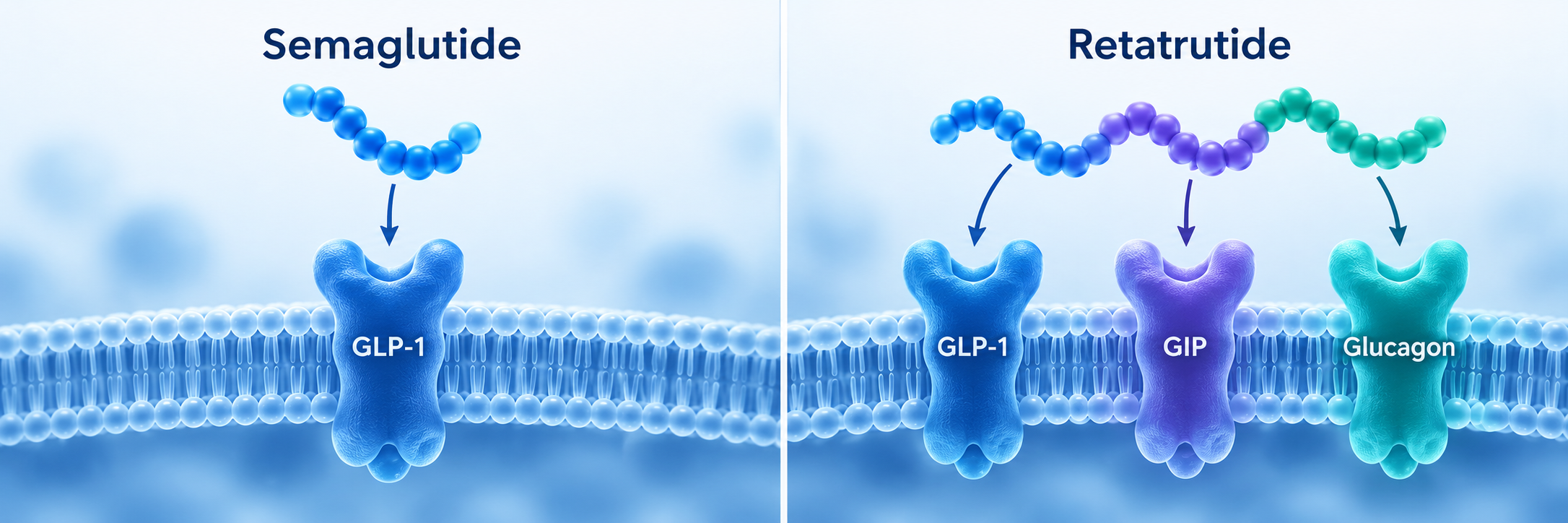
Semaglutide: GLP-1 Signaling
GLP-1 is a hormone involved in the body’s response to nutrients.
Semaglutide activates its receptor. Relevant effects include glucose-dependent stimulation of insulin secretion, reduced glucagon secretion, and delayed gastric emptying. Semaglutide also influences appetite and calorie intake.
Its metabolic activity therefore involves both food-related signaling and blood glucose regulation. Describing it only as an appetite suppressant leaves out an important part of its biology. [2]
Retatrutide: Three Receptor Activities in One Molecule
Retatrutide combines activity at:
- GLP-1 receptors, associated with glucose regulation and appetite-related signaling.
- GIP receptors, involved in nutrient responses and glucose-dependent insulin secretion.
- Glucagon receptors, involved in glucose production and broader energy metabolism.
The original discovery program investigated how these activities could work together. Preclinical experiments linked glucagon-receptor activity with energy expenditure, while early clinical research explored glucose and body-weight outcomes. [3]
This coordinated approach is a central reason for interest in retatrutide.
Its appeal lies in exploring several connected metabolic pathways within one molecule. However, the balance of those activities matters more than the number of receptors alone.
Can One Receptor Explain the Difference?
A head-to-head trial evaluates the complete intervention.
It does not separately switch each receptor pathway on and off. Consequently, the overall difference between groups cannot be attributed entirely to glucagon, GIP, or another individual mechanism.
The biological design explains why a compound is worth investigating. Clinical outcomes show how that complete design performs under the conditions studied.
What Makes These Findings Valuable?

A Direct Test of a Distinct Metabolic Approach
The strongest feature of the new comparison is that it evaluates two approaches within a shared study framework.
Separate trials can differ in diabetes status, starting weight, background medication, follow-up, and analysis methods. Comparing their headline percentages can therefore create an incomplete picture.
A randomized head-to-head study reduces some of those difficulties.
For readers following retatrutide clinical trials, this adds something useful: evidence that directly tests how its combined receptor approach compares with an established GLP-1-based medicine.
It also moves the discussion beyond a promising mechanism. The development rationale can now be considered alongside measurements from a comparative human study.
Weight and Blood Sugar Outcomes Together
A1C and body weight describe different aspects of metabolism.
A1C reflects longer-term blood glucose exposure. Body weight measures total mass. An improvement in one does not automatically establish an improvement in the other.
Evaluating both provides a broader picture of the response.
The units also matter. An A1C change expressed in percentage points is different from a relative percentage reduction. Similarly, a percentage change in body weight describes change relative to starting weight.
Looking at these outcomes together helps explain why interest in metabolic peptides extends beyond appetite alone.
Does Greater Weight Loss Mean Greater Fat Loss?
Body weight is an important outcome, but it does not fully describe body composition.
A change on the scale can involve:
- Fat mass.
- Lean tissue.
- Water.
- Other components of total body mass.
A weight-loss percentage therefore cannot establish a particular amount of fat loss or muscle preservation without corresponding measurements.
Fat distribution is another separate question. Total weight does not distinguish abdominal subcutaneous fat, visceral fat, or fat within the liver.
Our Tesamorelin visceral-fat article explains why measuring a particular fat compartment answers a different question from measuring total weight.
For this comparison, the reported endpoint supports a conclusion about body weight. Claims about muscle preservation, regional fat reduction, or “fat-burning ability” require additional evidence.

How Did Tolerability Compare?

Gastrointestinal events were prominent in the announcement. Dysesthesia—altered or unpleasant sensation—was also reported.
| Discontinuation because of adverse events | Reported rate |
|---|---|
| Retatrutide 9 mg | 4.8% |
| Retatrutide 12 mg | 7.9% |
| Ozempic 2 mg | 2.7% |
These findings should be considered alongside efficacy. [1]
An adverse event and a treatment discontinuation are different measurements. Someone may experience an event and continue treatment, while another participant may stop.
The full analysis will provide more detail about event severity, timing, duration, and reasons for discontinuation. Those details help establish the overall treatment profile.
How Far Does the Comparison Extend?

The Comparator Was a Specific Ozempic Regimen
Lilly described Ozempic 2 mg as the highest approved injectable Ozempic dose.
The findings should remain attached to that comparator. They do not automatically establish the same relationship with every semaglutide formulation or regimen.
The Population Had Type 2 Diabetes
Diabetes status and other baseline characteristics can affect the interpretation of metabolic outcomes.
A separate published retatrutide obesity trial studied adults without diabetes under a different protocol. It adds to the development background, but its figures should not be merged with the new comparison as though they came from one dataset. [4]
Tirzepatide and Combination Claims Are Separate Questions
A comparison with semaglutide cannot settle how retatrutide compares with tirzepatide.
Similarly, different mechanisms can motivate combination research without proving that combining compounds produces an additional benefit.
Each question requires evidence designed to answer it.
What Should Readers Watch for Next?
The complete findings have not yet been presented and published in a peer-reviewed journal.
The most useful additional details will include how responses varied between participants, how alternative analyses handle treatment discontinuation, and the complete safety findings.
These will deepen the initial comparison rather than replace the central question: how does the overall metabolic response differ under a defined set of conditions?
For a related discussion, our AOD-9604 fat-metabolism article explains why releasing stored fat, oxidizing fatty acids, and reducing body fat are also separate measurements.
Frequently Asked Questions
Is Retatrutide the Same as Ozempic?
No. Ozempic contains semaglutide, which activates the GLP-1 receptor. Retatrutide is a different molecule combining GIP, GLP-1, and glucagon receptor activity.
Is Retatrutide Better Than Semaglutide?
For the reported weight and A1C outcomes in this trial, the results favored retatrutide. That conclusion applies to the studied population and preparations. A broader assessment also needs tolerability and the complete findings.
Is Retatrutide FDA Approved?
Retatrutide remains investigational as of this review. Positive trial results do not themselves constitute product approval. [1]
Does Triple-Receptor Activity Automatically Mean Better Results?
No. The receptor profile explains a development strategy. Human studies establish how the complete intervention performs for particular outcomes and populations.
Do Clinical Results Apply to Separately Supplied Peptide Materials?
The results concern the pharmaceutical preparations used in the study. They do not independently verify another material’s identity, quality, or suitability for human treatment.

Why This Comparison Deserves Attention
Retatrutide is attracting interest because its distinct receptor approach can increasingly be evaluated through comparative human evidence.
The new study connects that biological rationale with measured metabolic outcomes. It provides a more informative basis for understanding the compound than receptor diagrams or comparisons between unrelated trials alone.
Keeping the population, preparation, and endpoints clear makes the positive findings more useful for both general readers and businesses following metabolic peptide development.
For enterprise procurement, distribution, or research-material projects, contact Novacybio to discuss available retatrutide and semaglutide material specifications and supporting documentation.
Last reviewed: October 30, 2026.
References
- Eli Lilly and Company. Lilly’s retatrutide delivered greater A1C reduction and more than double the weight loss of Ozempic’s highest approved dose in head-to-head trial. October 28, 2026. Sponsor topline announcement for TRANSCEND-T2D-2. Source
- U.S. Food and Drug Administration. Ozempic (semaglutide) prescribing information. 2026 label. Source
- Coskun T, et al. LY3437943, a novel triple glucagon, GIP, and GLP-1 receptor agonist for glycemic control and weight loss: From discovery to clinical proof of concept. Cell Metabolism. 2022. doi:10.1016/j.cmet.2022.07.013. Source
- Jastreboff AM, et al. Triple-Hormone-Receptor Agonist Retatrutide for Obesity — A Phase 2 Trial. New England Journal of Medicine. 2023. doi:10.1056/NEJMoa2301972. Source